




Alison Garwood Jones

Going graphic

November 3, 2011

Dispatch from the annual Design Thinkers conference put on by the Registered
Graphic Designers of Ontario.


.

Comment on this post »

Street talk

October 31, 2011

I’ve often wondered the origin of street names in Toronto, especially when I have work to do. If you’re looking for a distraction too, here’s some trivia:

Queen Street: Named after HRH Queen Victoria. Formerly called Lot Street.

King Street: Another royal road, King Street was named after King George III, but has also at one time or another been called Palace Street and Duke Street. And, yes, that’s Mad King George or the same King George who lost America.

Roncesvalles Ave: Now pot-hole free and bike-friendly, Roncey was named after a battle in Spain (1813) by Colonel Walter O’Hara, who also boasts a west end street in his name. Sorauren Avenue stands for another battle in Spain (1815). Nothing about either street feels Iberian.

Brock Ave: named after James Brock, cousin of Sir Isaac Brock, the administrator of Upper Canada killed at the Battle of Queenston Heights.

Jameson Ave: Named after Robert Sympson Jameson, lawyer, politician, judge, blah, blah, blah, and not half as interesting as his estranged wife, Anna Brownwell Jameson, noted author of Winter Studies and Summer Rambles in Canada and Characteristics of Women. When Robert was named Chief Justice of the province of Upper Canada, Anna was summoned from England to Canada. The marriage, already in trouble, spiraled further when hubby forgot to meet Anna in New York for the trip up to Canada. She bushwacked her way north to Toronto alone through the snow, no doubt writing entire books in her head during the struggle.  The marriage ended, but her love of writing and hiking only grew. Today, Anna’s a rock star in literary circles, championed by the likes of Margaret Atwood and Charlotte Gray. The street might as well be named after her.

Landsdowne Ave: Named after Henry Charles Keith Petty-Fitzmaurice, 5th Marquis of Landsdowne and GG of Canada from 1845-1927. Incidentally, he looked like a Russian Bolshevik with his fur hat and giant, black mustache.

Source: Parkdale in Pictures, Toronto Public Library Board, 1991.

Comment on this post »

Just so you know

October 29, 2011

“There is no fiction and non-fiction as we commonly understand the distinction; there is only narrative.” — E.L Doctorow

Comment on this post »

RIP Homemakers

October 27, 2011

One of my employers died last night.

Homemakers Magazine was 45 years old, but her time had come. A combination of factors did her in: the economy, the rise of digital media, questions about her relevance in the face of competition (Canadian Living, Chatelaine, Good Housekeeping). D.B. Scott’s obit is worth the read.

Despite her pre-Friedanian name, Homemakers was a trailblazer in women’s rights. Her content was always relevant and never frivolous. Former editor Sally Armstrong travelled the globe filing stories on the state of women’s lives in the developing world, often compromising her own safety to do so.

Truth be told, it’s not a fun time to be a staff journalist. I doubt the average citizen knows that. Many assume the romance of journalism continues based on the Woodward/Bernstein plucky model. But too many printed magazines and newspaper are hanging on by their cuticles right now. Budgets are down, work is up and shareholders and publishers are pounding fists on desks demanding results. At the back of the office, digital departments are wailing, “Throw more money our way. Can’t you see the future is now?” Too many people in power, though, continue to be invested in the old way of doing things, hoping this is just a blip in the profit margins because print still feels sexier, more prestigious.

Meanwhile, the landscape continues to explode and burn like the oil wells in the first Gulf War. Talented staffers are being spit out on the street. But after the drama of trying to hang on, and sacrificing so much in their personal lives and health to make it happen, the silence is welcome in many cases.

This was my final article for Homemakers. (* P.S. fellow writers: I only agreed to sign a “one-off” contract with Transcontinental provided they pay me considerably more money for the rights they took back. For those of you who feel timid asking for more, I recommend joining Derek Finkle’s agency).

And here’s a reprint of related post about living the dream (and frying out in the process) written last spring. If you’re under 27, this won’t make any sense. Go back to blogging for free. :)


Working at a magazine or a newspaper lets you write about life, but really experiencing it is another matter.

In your twenties, that’s fine. You’re happy to let your job define you. You’re also totally thrilled to be giving yourself over to the romance of print media. Your friends who work at the bank couldn’t be more jealous.

In your thirties, the life you’ve chosen can start to take its toll. But you never admit that (your friends still want to be you). Dashing around town collecting swag bags begins to feel empty.

By your forties, the pace can become unacceptable, even if the act of writing is still meaningful.

Getting fired is sometimes the only way to escape this life of relentless deadlines.

This is what happened to Dominique Browning (pictured above at her home in Rhode Island). Browning is the former editor in chief of the now defunct House & Garden, and she writes with searing honesty about her life before and after Condé Nast in last Sunday’s New York Times Magazine.

Here’s a taste:

The thing about running a magazine is that there is always too much to do. I liked not being in control of my time — I was always busy. I didn’t want time to think things over, things like feeling guilty about spending more time with my office mates than with my children; feeling sad that those children were leaving home; or feeling disappointed in love or frightened by terrible illness. Everything else, in other words. The demands of my job kept me distracted.

A lot of actors say they get into film and TV because they don’t want to play themselves.

I wonder how many editors can relate?

Comment on this post »

True beauty

October 26, 2011

At The Bay, Queen Street, Toronto — October 25, 2011

Comment on this post »

It’s just a phase

October 25, 2011

Journalists go through phases. During and right after I left Elle Magazine, my beat was lipstick. I was the beauty editor. I reported on shade ranges, hero ingredients and cupids bows for years until I finally managed to write my way out of the pink ghetto.

Beauty editor: I looked the part, but didn’t think the part.

Then I started banging out health features and talking to more psychologists and cognitive scientists and fewer makeup artists and dermatologists. Women care a lot about surfaces so it was humbling to move inside the body and take a closer look at things like cell division (the ultimate crap shoot) and neuroplasticity, a new arm of brain science that shows how negative habits and beliefs literally carve pathways in our brain, determining behavior, whereas positive habits can reshape the brain until those old pathways grow over like unattended lots. Neuroplasticity forever puts to rest the assumption that change after a certain age is impossible. Linda Page, a Princeton sociologist and life coach put me onto this. The article where it appears hasn’t hit newsstands yet.

Moving farther away from my powder pink beginnings, I gravitated toward the sharp primary colours of Google and starting having long and winding conversations about creativity and technology with masterminds like Robert Wong who heads up Google’s Creative Lab from the company’s New York headquarters. After that, I talked to the inimitable George Lois, ad man, art director and cultural provocateur.

Still, the surfaces didn’t disappear. They never will. Now when I write about women’s faces and bodies I look at things through my feminist lens, the same one I put in in storage all through the Elle years (it was a source of frustration that no amount of free lipstick could quell). Today, when I can, I use my lens to burn holes through all of our obsessions and warped concepts about women, so many of which start on the newsstand. Hopefully I ignite a few minds too, like here.

© AGJ on Picnik.com

My most recent spate of assignments focuses on dwellings.

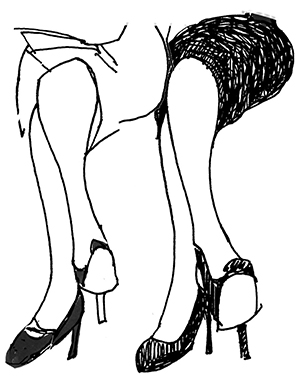
Drawing by Marcelo Rampazzo

I appear to be in the “shelter phase” of my career. I have two house profiles on newsstands right now and a third in production.


One is for Design Lines and the other for Canadian House and Home.

Happy reading!


Comment on this post »

“Kids today don’t know shit” — George Lois

October 18, 2011

Whenever anyone coos about the “Golden Age of Journalism” this is what they’re talking about:


And this:


And these:


Not this:


And and I worked for Elle, God love’em. But if you had to choose between

This                                        and                                      This

Which one stays with you? Haunts you? Plays on your imagination like a painting or a good book? It’s the Esquire covers by legendary art director, George Lois. Read about the time I met George here.

Maybe you’re thinking, yeah, but those subjects are too different: one shows Jessica Alba at the height of her acting and posing career while the other shows Muhammad Ali at the height of his fighting career, albeit banned from the boxing ring for refusing the call to military service (hence the martyr angle). If they feel too different, then try this:

Now you’re looking at Jessica Alba at the height of her posing career and some non-celebrity from the sixties tossed out of the game for being over 21.

The point being, you remember the cover that says the most with the least. “It’s like they’re trying to recreate the internet on the page,” George told me, pointing to all the verbal diarrhea on most covers (although I’m the one who chose the Elle cover). I called George at his Greenwich Village apartment last month and he was energetic, wildly profane and as opinionated as ever. “Every square inch of the page has information on it,” he continued. “That’s not the way to design a magazine. I’d take one-quarter of that information and do a graphic punch.”

I especially like magazine covers that tell us something fundamental about ourselves, like George’s commentary on ageism in America with the cover of the young woman in the trash can. He said he knew he would get flak for that idea and he did. Back then, anything grimmer than cheesecake was considered insulting to women. Forty years later, despite the march of time the Elle cover doesn’t question ageism it supports it with a chorus of  blinking cover lines about “plastic surgery’s dirty little secrets,” the “biggest age giveaways,” using sex to get ahead, and the best new shoes, bags, dresses and jackets. It’s scattered and exhausting and what’s worse, alarmism in aspirational clothing.


George is coming to Toronto next month to talk at the RGD (Registered Graphic Designers) Conference. He told me he’s on a mission. “I’m coming to Toronto because I wanna drill into everybody what great ideas are all about.” At 81 he’s still crossing the continent trying to get us thinking about the elements that go into effective design and meaningful cultural commentary. And it all starts with one sharp idea at a time. Here are just a few of his.


In 1965, before anyone had heard of Betty Friedan, Gloria (Glo Glo) Steinem, Germaine Greer or Women’s Lib, Lois reflected on the changes going on in women by doing a cover of a Marilyn Monroe lookalike shaving. “As a great designer, you should anticipate the culture. You should know what is coming. I knew the women’s movement was coming before women knew it. You knew it, you felt it in ‘em. All the women around me were getting stronger and tougher and weren’t taking any shit from anybody. The women were getting balls. I got it. I was working with women who did stuff, a TV producer who was incredible. She kicked ass. She wouldn’t take shit from me. She was delicious! So what do I do? I do a cover of a beautiful woman shaving. It knocks you on your ass. The wit’s there. The way she’s looking at you she’s saying, After I finish shaving, I’m gonna kick your ass. That communicates in a nanosecond. You get, you think about it and you remember it.”


Then there was the time George stood at the front door of CBS’s Studio-50 at Broadway and West 53rd and convinced that really big showman, Ed Sullivan, to come by his studio and pose in a Beatles wig. This was the week when America was just learning about the Fab Four. “When Sullivan finally came out I shoved a sketch of my proposed cover in his face and talked fast,” writes Lois on his website.” He took a long look and grinned ear to ear, just like the final shot we took the next day. He wore his wig with gusto and smiled like Ringo.”


Five years ago editor Tina Brown (formerly of the New Yorker, Vanity Fair and now Newsweek) sidled to George at a party and said, “God George, your Esquire covers were genius but you can’t do those kind of covers any more.” “Why the hell not?” he asked. “Because ideas don’t sell anymore,” said Brown. “Waddya tawking about?” bellowed Lois in his fighting Bronx brogue. “C’mon, ideas are what make the world go round.” Brown went on about how newsstands are crowded with more titles, but Lois would have none of it. “You go to the newsstand now and there’s what, 150 covers? And my covers still leap out and grab you by the balls. It’s so obvious,” he said. Lois believes there are a ton of good graphic designers and ad men and women working today, but they’re working in a climate that rejects provocative commentary and the very notion of selling. When it comes to magazine covers the strongest show one idea, “like a beam of light,” Lois explains, pointing to his best covers of Muhammad Ali as Saint Sebastian and Andy Warhol drowning in his own can of soup. “Now, there’s a cacophony of cover lines and every square inch of the page has information on it, like a web page. Go for the graphic punch.”


Advertising also lacks conviction, says Lois, also legendary for his ad campaigns. Take car ads. “There’s no real winner or no real selling going on. Was that a Honda or a Mazda?” Lois believes the anti-sell is being taught in schools. “Don’t let them know you’re advertising. Don’t really mention the sale, just entertain. And I’m like, Are you kidding me? I entertain with wit, a sharp idea and a dramatic punch in the mouth. My commercials communicate in a nanosecond. You know I’m selling and you enjoy the hell out of being sold.”


George uses computers, he likes computers, BUT …  “I visit a lot of design schools and the students tell me about the projects they’re working on, but when I ask, ‘What ‘s the idea?’ they always say, ‘I dunno yet.’ ‘Then what are you doing at your computer?’ And they say, ‘Playing.’ ‘Well, then you’re playing with yourself; you’re just masturbating.’” It’s a problem when designers start designing before they have an idea, explains Lois. “You won’t get your ideas staring at a computer screen. You’ll get them by engaging with your surroundings, going to museums, studying art history, keeping up on the news.”


“This whole thing with the Twittering and the networking and the narcissism that goes on. The time spent keeping up with your friends is beyond belief. Then on top of that, you can get all the information you want online and it’s pretty correct, except for Wikipedia, but when you talk to young people they don’t know anything. When they learn something, they forget it because they know it’s there. They don’t try and retain it. When you talk to them about the history of art and the history of culture, of movies made in the 1930s and 1940s, the ballet, about anything, they look at you and say, Well, I wasn’t alive then. Then I say, ‘Well, I notice you’re wearing a crucifix. Jesus Christ died a long time ago but you know about him …’ They’re supposed to understand culture. If you don’t understand the culture you can’t do great work. You could even bring up Muhammad Ali today and they don’t know what I’m talking about. I’ve been to the Met 5000 times. Every time I go I have an epiphany over something I didn’t quit notice before. It’s all the Shock of the Old. If you don’t know the history of art and design you’re unarmed. It’s a sad future when your young people don’t know shit.”


“I gave a talk a few years ago to magazine editors at a conference. They wanted me to do a talk on magazines covers and ripped their eyeballs out. They were looking at the covers I did 45 years ago and going WOW! About every 15 minutes I would berate everyone in the room. I would say to them, every magazine in this — and there were about 800 editors from hundreds of magazines — except maybe Vanity Fair and the New Yorker were complicit in the Iraq War. You all sat there and ate that bullshit up with a spoon. And anyone with half a brain knew that Bush was making things up and Cheney too. And I stunned them. Fifteen minutes later I said it in a different way and there was some applause. About half and hour later I said it again, standing ovation and they were saying, Yeah! We were complicit in the war. It was amazing. The point is: if you’re a designer you have to be a humanitarian. You have to speak truth to power. If there’s shit going on, you should figure out how in your job you can fight the bad guys”


“Magazines should not be designed for the reader. Great editors and great art directors should be designing a magazine for themselves. What kind of magazine would I love to read? What should be in it? What would it look like? You shouldn’t be saying, what does the public want? Let’s go out and do some research to find out what they want. What do they know what they want? I don’t believe in group gropes” All of this reminds me of Steve Jobs who, when asked how much market research he did when developing the iPad, responded, “None. It isn’t the consumers’ job to know what they want.”


George inspired Matt Weiner to create the TV show Mad Men. But that doesn’t sit too well with him. “Right before the show premiered, everyone in town was saying to me, Hey there’s a show called Mad Men coming to TV and we think it’s about you! People called me up and said are you doing that show? I said, No. I don’t know what it is. They were promoting it as a show about advertising in the sixties. Instead, it’s a typical talentless, schlocky agency where the ad executives are schtupping their secretaries and smoking themselves to death. We didn’t’ spend the day sitting around. We were thinking, doing comps, running out to film shoots, going to commercials, doing my story boards all night. Who had time to get laid?”


Comment on this post »

Happy Thanksgiving

October 10, 2011

Ready … Set … Go!


Zzzzzzzzzzzz


©AGJ on Sketches

Comment on this post »

Fade to black

October 6, 2011


Steve Jobs (1955-2011)

©AGJ on Sketches

Comment on this post »

Change jar

September 19, 2011

©AGJ on the Sketches app


When times are tough, the change jar buys dinner.

I bet rich people throw out their pennies.

I eat mine in the form of butter fish, rice and slivers of unagi and pickled ginger.

If God is in the details, being cash-strapped sure helps you worship of the small stuff.

Starving artists are on to something …

Comment on this post »

error: Content is protected !!