




Alison Garwood Jones

A day in the life of James Franco

March 5, 2011

James Franco Twist

Comment on this post »

Old habits die hard

March 3, 2011

We all have our coping mechanisms for getting through life, habits we pick up as youngsters or fall into as adults. Some are private and gross (toe nail biting) or public and determined (nose picking). A few enlighten and engage the human spirit (reading), while others are mechanical and redundant (hand washing), or lonely (midnight bingeing). Some are welcome (tidying up) until they turn extreme (obsessive label-making). And one, in particular, is just plain annoying (whistling).
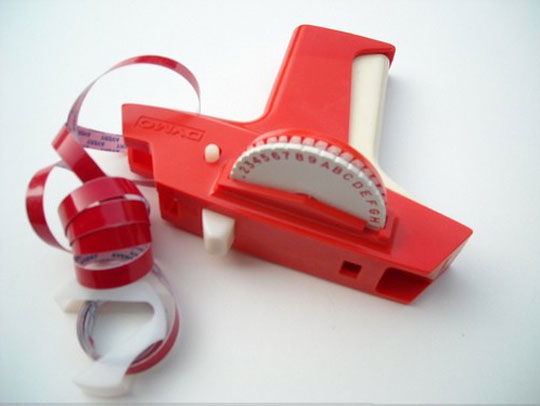
Label Maker

But none of these habits are hurting anyone else. They may raise an eyebrow (the toes), then furrow them (the whistling) or be a good reason for deep concern (doesn’t bingeing stem from things left unsaid?), but they don’t physically alter someone else’s cell division or longevity.

To do that you would have to get hooked on what one third of the world is doing every day, every hour and minute for any number of reasons: to calm their nerves, escape boredom, fill in uncomfortable pauses in conversations or melt extra fat.

You’d have to strike a match and start smoking.
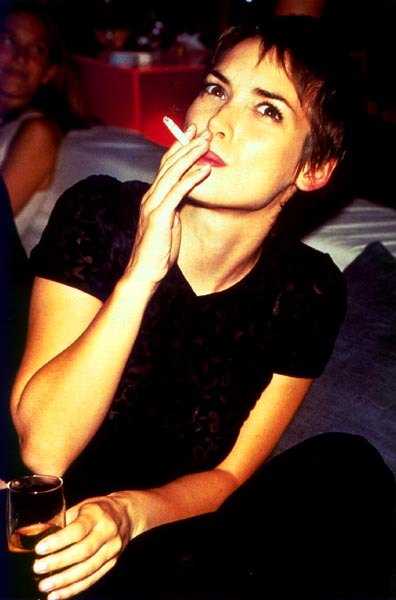
WinonaI’m Winona Ryder and try as you might, you’re not.

I write for a living, but I work at a bar at night to help pay my bills. I do it because it’s fun and because publishers mostly don’t listen (or ever call me again) when I say, “Hey, you should pay me for those extra rights you just took away.” Working in a bookstore would be fun too (and more me), but I need my days to write. And I need the tips. What I don’t need is the smoke.

When smoking was banned inside Toronto bars and restos five years ago, the problem didn’t go away. It just moved. And I moved with it.

In the summer when I manage the patio I’m constantly dashing around trying to avoid the exhales of smokers. Sometimes I’ll place feeble little notes on the backs of business cards — “Please don’t smoke here. Move to the end of the patio. Thanks!” It’s silly, I know. They’re not breaking the law. Anyway, most of them turn my pleas into coasters when they drop their pints to light up. I have to turn up the wattage in my smile when I ask smokers standing at my work station to take it elsewhere. The withering looks I get say it all: Aren’t we uptight? Or my favourite: “Then don’t work here.” Others direct my attention to the cars zooming past us on the street. “Those cause more pollution, you know.”

Well, I don’t drive, but I do smoke thanks to them.

Rather than wallowing in my utter powerlessness or pulling cigarettes from the lips from every smoker who gets in my air — like Karsh did with Churchill’s cigar right before he captured history — I decided to get on the phone and look for scientists to fill my corner. Here’s an article I wrote about the health hazards of sitting beside smokers on patios that quotes a couple of those scientists. Patios became a hotspot for smokers after they were kicked outside. Building entrances became another. All this exposure to outdoor secondhand smoke can’t be good for me.

“It’s not,” says Pam Kaufman. I found Pam at the University of Toronto in the offices of the Ontario Tobacco Research Unit. She just published ground-breaking research on people’s outdoor smoking habits. She and her team strapped on air monitoring backpacks and spent two months testing the air quality at building entranceways in downtown Toronto (28 buildings to be exact).

In a nutshell, Pam found that when smokers hover at entranceways to office buildings and hospitals the people going in and out of those building end up breathing in 2.5 to 3 times more toxins than they would if smokers weren’t around, and smog from cars and industry was the only thing to worry about.
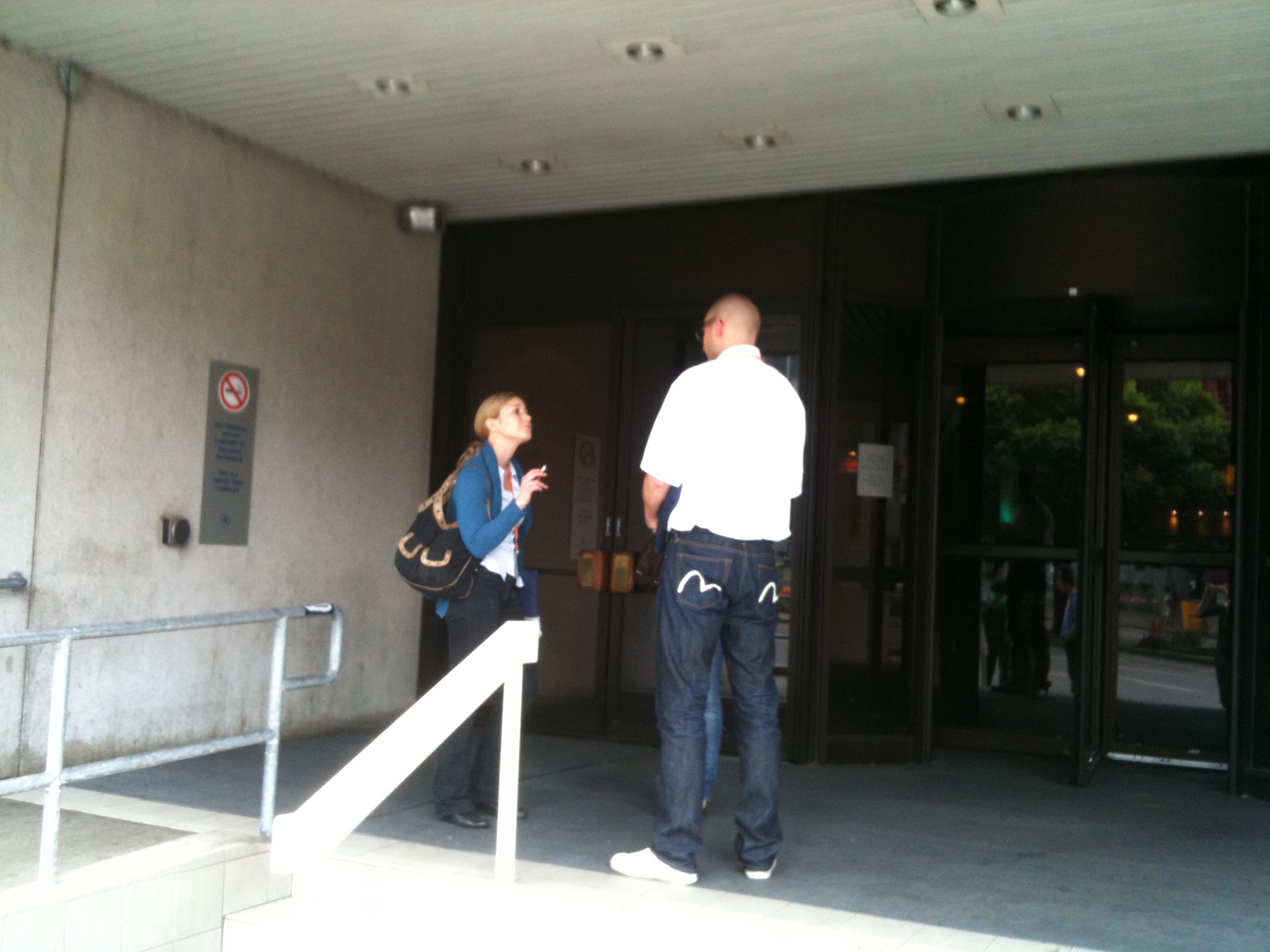
IMG_0134Signs across the city, like this one at the Hilton Hotel, ask smokers to move 9 metres (30 feet) from entranceways. But that’s just moving the problem a-gain. The question is: where can we put smokers so they don’t affect the rest of us?
What in the blazes is going on with my fonts? My HTML commands are not sticking. I’m emphatic about this subject, dear readers, but not THIS emphatic. Sheesh.

“Hard data has been the missing link in outdoor secondhand smoke research,” she told me, in one of our many long phone chats. Putting this into perspective, Pam explained that secondhand smoke at peak smoke break times can and frequently does cross into the “hazardous” zone established by the Environmental Protection Agency’s Air Quality Index. “It’s not just a few wisps,” she says. Still, it’s tricky. “No one has studied the cumulative effect of these transient bursts of secondhand smoke, but all the evidence suggests that no level of secondhand smoke is safe.”

Click here if you want to read my latest story at OpenFile.ca.

Picture 1

Half empty

Working at a bar also gives me a front row seat to another addiction that harms more than the person doing it. Of course, I’m talking about alcohol.

IMG_0045-200x3001-150x150I see the same grown men (and some women) sway past me on every shift. As the night wears on and the dinner crowd thins out, I watch them sitting at the bar, saying yes with their eyes to another drink as the bartender looks their way. I think about them and I think about myself too and how I’m handling my life. I don’t really understand what triggers each of us to unfold in such different patterns. Experiences? Chromosomes? Broken hearts?

There are lots of theories about addiction. David Carr, a former addict, thinks his drinking and drugging was an attempt to simplify his life:

While other people worry about their 401(k)’s, getting their kids into the right nursery school and/or college, and keeping their plot to take over the world in good effect, a junkie or a drunk just has to worry about his next dose. It leads to a life that is, in a way, remarkably organized. What are we doing today? Exactly what we did yesterday. And a drunk or junkie [can always find] fellow travelers.

(From Carr’s book, The Night of the Gun. Scroll up on the right, it’s featured in my “Books I Love” section)

Kelsey Grammar thinks his addictions to alcohol, drugs and marriage stem from unresolved grief (both his sister and his father were murdered). Deepak Chopra says addiction starts as a search for something more. “It’s a search for joy, a search for [some kind of] exaltation and somehow it goes the wrong way,” he told a gathering last week in Squamish, B.C. “In my experience,” he said, “people who have problems with addiction are really the most spiritual people of all.”

I’m counting on that to see them through.

Comment on this post »

Blogging

February 23, 2011

I don’t post every day. That’s so “early Web 2.0.”

Comment on this post »

Musical interlude

February 18, 2011

I interrupt the wordy side of this blog for a little French street dancing music. Twirl your partner, then bow and go for wine.


Comment on this post »

February 14, 2011

lovebegets25 NO2

By the uber-talented Hugh MacLeod (thanks for giving me permission to post this, Hugh!)

Comment on this post »

Hubba hubba boo hoo

February 7, 2011

A study on human behavior released last month reminds us that spontaneous impulses have tipped entire cultures in a certain direction, and that fighting against human nature — especially the male nature — is monumentally difficult.

No wonder feminists have a reputation for being pissed off all the time.

The study deals with beauty, and how men absorb less information when the person delivering it is a gorgeous female. Researchers at Indiana University rounded up almost 400 male and female volunteers and had them watch a 24-year old female anchor deliver the day’s news dressed up first in a sexy get-up, then as a plain Jane.

In short, after watching Sexy Anchor in her fitted jacket, red lipstick and sparkly necklace, the men hadn’t a clue what she had just said. Thankfully, there wasn’t a follow-up quiz because they would have bombed. But when the anchor avoided sexual cues, donning a lumpy jacket and plain lips, the men went right back to being statistical calculators — reaming off sports scores, political updates and pending weather fronts.

v6466g54

The female volunteers delivered a different story. Like a classroom, the gals retained more information than the guys regardless of the anchor’s appearance, and paid even more attention to the Sexy Anchor. The researchers say this is probably because they saw her as competition.

The trance-like effect of Sexy Anchor on men is a natural and persistent part of the male/female dance. And I don’t think it’s a stretch to say that it’s the biggest impediment (next to the challenges and interruptions of child rearing) that kept women out of universities and boardrooms for so long. Beauty interrupts the pace of learning and commerce (for men). But it heightens women’s attention spans, as the Indiana study showed. But where does that leave the woman sitting inside that beautiful body?

The Sexy Anchor effect explains why extremely good looking women still have a hard time being taken seriously as individuals in the wider world. Still, no one cries them a river because, well, they’re beautiful. That should be enough.

ult_emacpherson_01

Can you imagine Elle MacPherson (lounging above) thriving in a second career as a PhD in anything? Donning a book bag, glasses and a pencil skirt would be seen as nothing more than a seductive scheme to increase men’s pain, not an earnest attempt to tone down the visuals and develop another side of herself. I say this without even knowing if Macpherson has the brains or desire to pursue a doctorate, but I’m willing to bet that she chose a career based solely on her effect on others. That sort of power and attention is fun. Doors swing open and mountains are blasted out of the way to make room for The Body, as she’s affectionately known. By the way, Macpherson is now an underwear mogul.

Of course, if a stunning woman doesn’t choose a life in modelling or become an arranger of lacy scraps over body parts, people wonder why, then pretty much ignore the field she pursued instead.

“What a waste [of beauty],” they say, shaking their heads. “Just think of the money and all the rock stars you could have dated.”

“But don’t you want to hear about my new genetic finding in fruit flies?”

“Not really… Hey, are you still wearing that pencil skirt?”

Mayim-Bialik-Photo-AlbumAfter starring in Blossom, Mayim Bialik (left) went on to earn a PhD in neuroscience at UCLA, but somehow we can accept that because she looks like she could do that. Now Bialik plays a brainiac on Big Bang Theory. I sometimes wonder how valedictorian Cindy Crawford would have fared as a chemical engineer (she studied it on scholarship at Northwestern University, before quitting to model). Her total grasp of the material isn’t in question, but her acceptance in the field is another matter. Maybe she could sense that and fled before having to face that uphill battle. Buildings and bridges are probably safer now because the guys she would have worked with have been able to maintain their focus.

Looks streamline women towards certain opportunities and discourage them from others. It explains why women still hesitate  every morning in front of their closets. A female, especially an attractive one, has to calculate the best course of action for the day ahead: what to show, what to hide, how will she be received if she wears a certain ensemble. Guys think less when they dress. Whether he’s a geek with a closet full of Ts and hoodies or a broker with lineup of expensive suits, it’s all the same. He just rummages, sniffs and goes. Clothes for men are uniforms that give them full coverage and allow them to differentiate themselves by their brains and skills.

A guy in a bar once said to me, “Wow, beauty and brains are running neck and neck with you.” I thought that was a nice compliment. But I could tell it was a problem, a major conundrum for him. Looking back, it’s been a puzzle for me too. When I started this blog last winter, a guy friend and fellow journalist (whom I adore) asked me in all searching seriousness if my website might act more like a dating site for me than a forum for ideas? “I am curious about whether there will be any unintended consequences to it,” he wrote in an email. “I wonder if  you are going to find yourself significantly digitally hit upon?” If anything, this comment shows that sex is still the driving narrative of a woman’s life.

So to that I say, let’s hope this site attracts intelligence, whether he’s in a hoodie or a suit. I haven’t figured out what I’ll be wearing.

Comment on this post »

Google doodle

January 20, 2011

Cezanne Victoire 21

Cézanne was a Google doodle yesterday. That’s because he turned 172.

I was glad to see he made it into this digital pantheon.

Google DoodleSee? It spells out G-o-o-g-l-e

Usually the kids at Google HQ reserve the space around their name for astronauts and civil rights leaders — you know, more splashy role models. I wouldn’t even say Cézanne is that well known outside the art world. He wasn’t an Impressionist, even though he was French and lived through that period. His brushstrokes and palette took him in a different direction which landed him on fewer umbrellas and tote bags. But I like the guy, despite my better judgement. And I love his art.

Cézanne was a grumbler, a mumbler and a first-class curmudgeon, the sort of guy who’d fling open his shutters and scream at distant barking dogs when they interrupted his thought process (not what you’d expect of a resident of Provence, now that bourgeois mecca for cooking show enthusiasts and coffee table book collectors). In short, he was the Boo Radley of Aix. Neighbourhood boys would hide behind bushes waiting for Cézanne to leave his apartment so they could pelt stones at him as he ambled along the crunchy gravel paths leading to the summit of his beloved Mont Sainte-Victoire (pictured above). He’d scream and wave his cane at them. Even his coachman got an earful: “You what? You raised the price of the carriage to Château Noir to three francs return? You’re fired!”

Not surprisingly, his wife Hortense lived elsewhere. But it was better that way. She was an inveterate gambler and spent more time in casinos than art galleries. One bad match turned Cézanne off all other future prospects. It also made him replace the female model he needed for his art with marble sculptures. He did stay in close contact with his son, though, but only through letters.

Today Cézanne’s shoe prints are cast in metal along a number of roads and paths he regularly took. I followed them like a dance chart the last time I was in Aix. He would have hated being hounded like this. But hundreds of thousands of people do it every year.

Here’s Cézanne taking a chair out into his garden so he can paint. Watch out for stone missiles, old man!

Cézanne's chair

To his detriment, I suppose, Cézanne never hid the fact that life overwhelmed and confused him. That’s why his art and biography resist the rosy, romantic haze that’s settled over Monet and Renoir, and why many people, including me, appreciate how persistent he was in trying to resolve his confusion through art.

That confusion made him ill-mannered and probably paranoid  — in short, not the sort of guy you’d invite to parties (Toulouse Lautrec knew how to whoop it up, while Manet was courtly to his core and great dinner party guest). Not Cézanne. Here’s what I mean, “All my compatriots are hogs compared to me,” he wrote in a letter to his son. “I can never get away from the meanness of people, be it theft, complacency, infatuation or violation, the seizing of my work. And yet nature is beautiful.” But even that beauty caused him pain. “I’m so slow at realizing my ideas and that makes me very sad,” he said.

One day, while painting only a few hundred yards from his studio the clouds turned black and boiling and a thunderstorm cracked the sky in two. But Cézanne kept painting through the lashing rain. “I cannot attain the intensity unfolding before my senses.” He continued his research indefatigably because painting was his consolation against life. A few hours later a laundry cart picked him up and two men placed him on his bed. If Cézanne were a novel, William Styron would have written it and Alan J. Pakula would have directed the movie.

Cézanne turned to painting like prayer (since God didn’t have his ear). It was a daily ritual, part of his search for answers, and a way of giving thanks for the abundance of beauty around him. To give order to the barrage of sensations fighting for attention in his chatty mind he developed a painting stroke that organized colour into something that looks like a lineup of mosaic tiles. Renoir’s strokes were fluffy, Seurat’s dotty, but Cézanne’s strokes clicked together like puzzle pieces, or piano keys. There’s a beat to the order of his brushstrokes that holds you in front of his paintings before you realize you better move on, other people need to look. To me it feels like tribal music. The strokes take control of the rhythm of my heart. Everything Cézanne saw and painted got that treatment, from the mountain all the way down to an apple.

Single Apple

And it was with an apple that Cézanne took Paris and the world. And now Google.

Comment on this post »

Je chante

January 13, 2011

I’ve made lots of mistakes in my time, but I narrowly missed this one: background music on my website.

When I launched my site last January, I imagined my home page, seen here,

Home Page 2

… uploading to the sound of Charles Trenet‘s plucky 1940s song, Je Chante (♪I Sing♪). It reminds me of snooty French curators, Jean-Paul Sartre’s wandering eye and primary schoolers in boater hats lining up for a field trip. Of course, none of these things have anything to do with my life, but I find all of it strange and interesting and totally charmants.

Still, the song works better as a post, not a permanent feature.

Sit back, then, close your eyes and listen all the way through as Trenet’s Frenchiness intensifies. “Qui, Qui, Qui, Qui!” he growls at the one minute: fifty mark. 

If you’re anything like me you’ll laugh out loud and settle into a warm, soignée feeling.

(Note: the freeze frame on this video is unfortunate — the outstretched arm and all. Trenet was actually a significant figure in the French resistance.)


Comment on this post »

Quote of the year (it came early)

January 12, 2011

“Everyday life now means living beyond our means.”

Jason McBride, “The Unaffordable City,” Toronto Life (February 2011)
*Update: This article isn’t about feeling entitled to the best of everything, it’s about the rising cost of living and struggling to pay for the basics. It’s not online yet.

Comment on this post »

Mailbag

January 7, 2011

I got a flurry of e-mails (I define flurry as “more than five,” and I got six), asking about a photo I posted last fall showing a lineup of shoes and overturned boots along a river promenade. “What is it?” they asked.

Holocaust Memorial

It’s the Holocaust Memorial in Budapest, Hungary. I got down on my belly to take this shot. The memorial is 40 metres long on the Pest side of the Danube — in the shadow of the Hungarian Parliament Buildings — and shows 60 pairs of 1940s-style cast-iron shoes belonging to men, women and children.

Through the summer and winter of 1944 and 1945, when the Swedish diplomat Raoul Wallenberg was in Budapest, he worked around the clock to save the Jewish population from Hungary’s fascist Arrow Cross officers. Many had already been deported to extermination camps around Europe. Wallenberg arranged for hundreds of Jews to be housed in buildings he rented around the city, including the Swedish Embassy, and defined these buildings as “off-limits” to the fascists.

It worked until it didn’t. On the night of January 8th, 1945   (66 years ago tomorrow), the Jews Wallenberg had been hiding in an apartment on Üllöi Street were rounded up by leather trench coat-wearing officers and lined up along the promenade, their backs to the river. As the Arrow Cross execution brigade waved their machine guns back and forth, releasing a barrage of bullets, their victims fell into the river.

My dad and I observed this memorial together. Years ago, he was the one who introduced me to Elie Wiesel’s Night. He pored over it with the same quiet intensity as Anne Frank’s Diary, which we both re-read in one sitting back in our hotel room in Amsterdam, two weeks after Budapest.

Comment on this post »

error: Content is protected !!