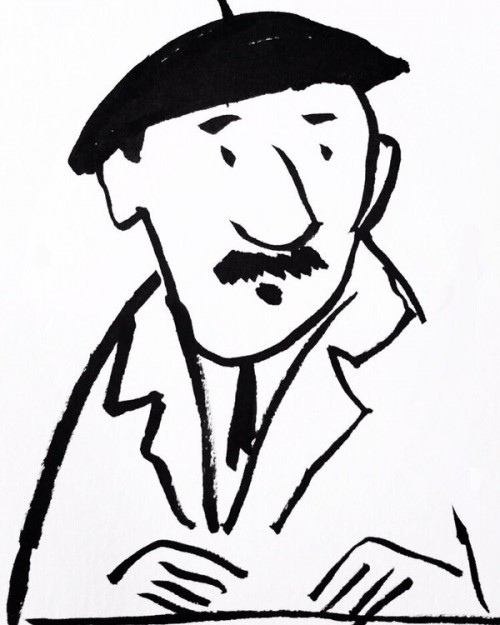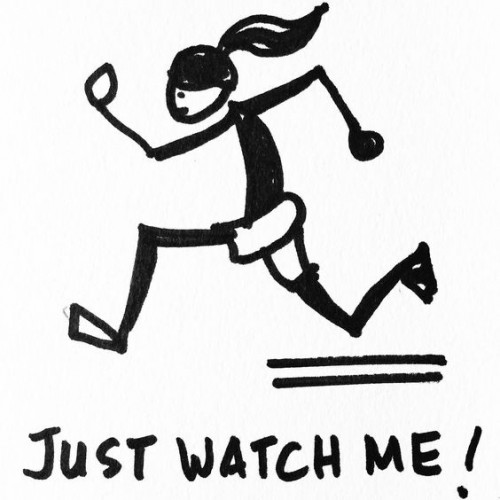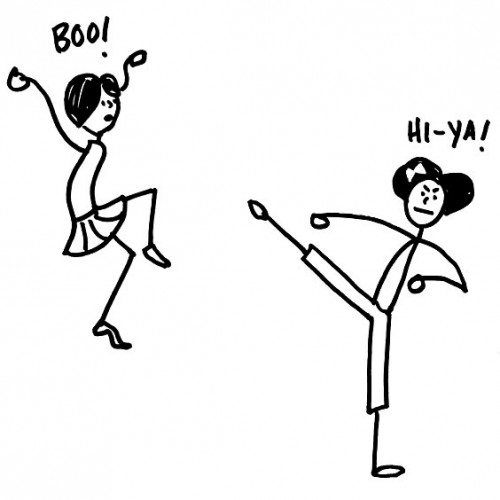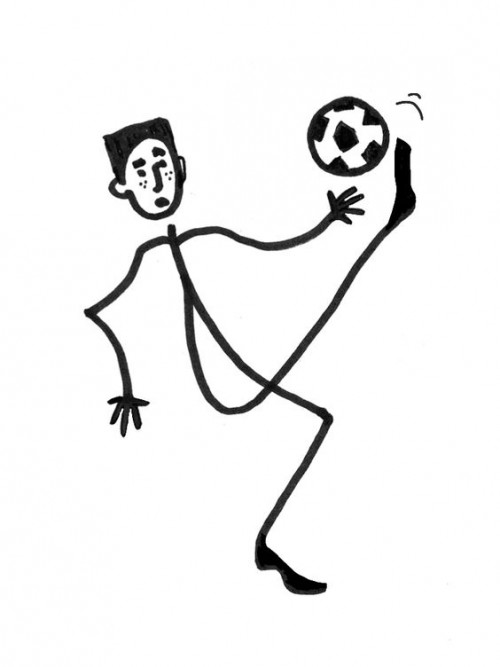





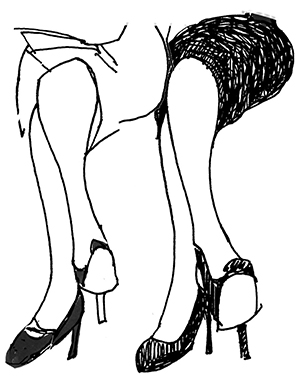
Gouache on paper.
Hat tip to Marion Denchars and her amazing creative exercises in Draw Paint Print like the Great Artists.





June 20, 2016
Gouache on paper.
Hat tip to Marion Denchars and her amazing creative exercises in Draw Paint Print like the Great Artists.
June 15, 2016
I briefly experienced Muhammad Ali’s dynamism and generous personality.
It was 1986, my high school prom, and word spread on the dance floor that Muhammad Ali was staying in a room at the hotel we had booked. A group of boys said, Let’s go up and meet him. I think I was the only girl who joined them.
Ali’s hotel door was open and he waved us in. He graciously shook my hand and then started play boxing with each of the boys, giving them his signature Ali smack talk.
Ali moved the culture forward. Black Superman, indeed.
No, just Superman.
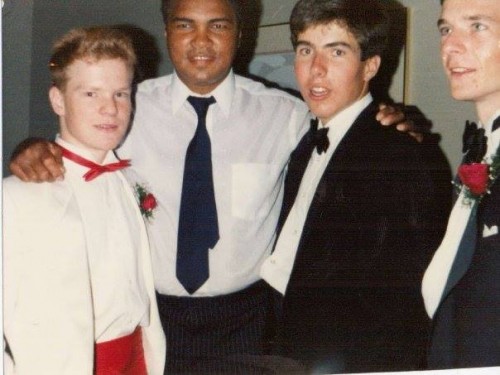 The Champ with Mark, Ian and Bill. I should have got in the picture!
May 19, 2016
 hen Anita Kunz was a five-year old growing up in Kitchener, Ontario in the early 1960s, she practiced drawing the usual kid stuff: horses, flowers, fluffy clouds. But making Crayola masterpieces for the fridge wasn’t enough. Anita drew with a stronger sense of purpose learned from her uncle, the artist and environmentalist Robert Kunz. His editorial illustrations for the “The Children’s Corner,” a weekly full-page section in the Toronto Telegram, introduced youngsters like Anita to a range of current affairs and delightfully drawn explanations of the world around them (things like, “where honey comes from”). “Uncle Robert taught me that an artist’s work could actually play a meaningful role in society and in culture, whether as education or journalism,” says Kunz. “That focus in me came very early on.”
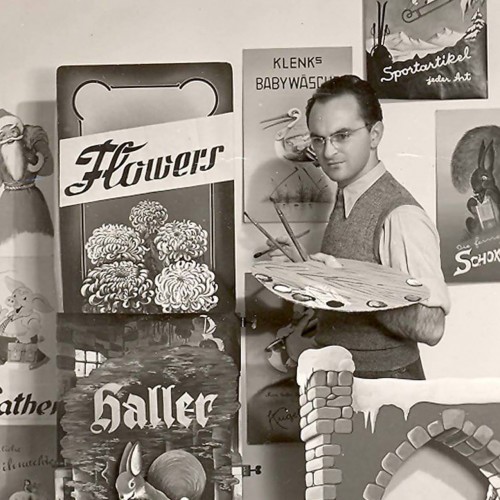 Anita Kunz’s uncle, artist Robert Kunz.
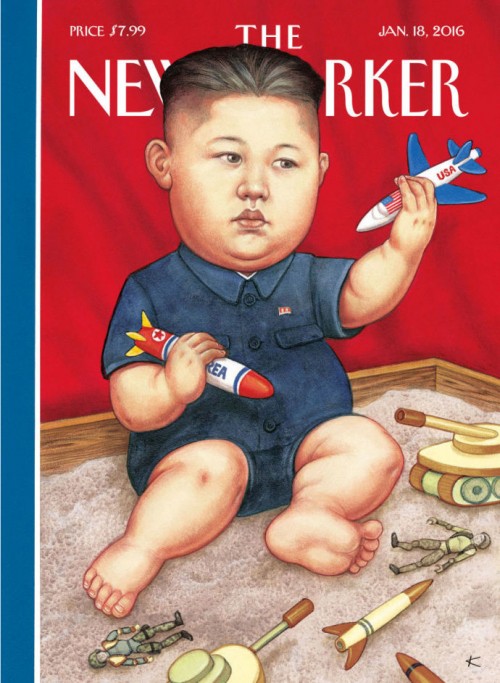
But whereas Robert Kunz’s cast of characters were dwarves and chatty forest creatures, like Mayor Rob Rabbit of Acorn Valley, his niece would eventually take on real political animals whose strange habits and questionable tactics were recast in her hard-won signature style: an off-kilter hyperrealism with elements of fantasy and surrealism. A naked and exposed portrait of President Bill Clinton for a 1998 cover of the now-defunct Saturday Night magazine is typical of Kunz giving her point of view as a feminist and democratic citizen. The same goes for her recent depiction of Kim Jong-un, supreme leader of North Korea, whom Kunz depicts as a big baby playing in his sandbox with some new toy nuclear missiles. “I have to admit,” says Kunz, “with that cover I had a few moments where I thought, ‘Oh, shit, are there going to be repercussions on the Internet?’” Like most of her illustrations, the idea was self-generated and pitched to The New Yorker, who put it on a cover this past January.
To students and competitors, Kunz is known for having scaled every mountain in publishing, multiple times, with her covers and editorial drawings for Time magazine, Vanity Fair, Rolling Stone, Atlantic Monthly, Toronto Life and The New York Times (the paper and magazine). For the first five years of her career, however, this OCAD grad (class of ’78, when it was still OCA) fielded one rejection letter after another. “I wish I’d kept them all,” she says. “People told me I wasn’t in the same league as some of the male artists.” Somehow, she blotted out the sexist insults and got back to work filling her “box of ideas” with funny and mournful sketched observations of human nature, while feeding off the socially and politically charged works of illustrators she admired, like Sue Coe, Brad Holland and Marshall Arisman.
[pullquote]Golden AACE Image winner Anita Kunz looks back on her 35-year career and how she developed a knack for sharp editorial commentary[/pullquote]
Given the widespread pressure to brand ourselves, Kunz likes to remind the curious and ambitious that she didn’t spring from the classrooms of OCAD fully formed (remember those rejections). “Everyone talks about a style and I know students just graduating especially feel pressure to settle on one, but my style evolved naturally.” It developed the way it did largely because she didn’t rely too heavily on references. “I drew from my head and that’s why my work has always seemed a bit wonky.” And she drew constantly. “The more you practice, the more you’ll get a look that’s uniquely yours.”
Her first significant assignment came in 1982 when Saturday Night art director Louis Fishauf, known for creating the brand identities for Roots, Molson and Toronto Life magazine, called on Kunz to render German war criminal Helmut Rauca. Rauca, a former SS Master Sergeant charged with killing over 11,000 Jews, was living freely in Toronto by the early ’80s. Kunz showed him as a skeleton twisted in the shape of a swastika and balancing the scales of justice filled with hands reaching up for help. More work from Fishauf and additional praise from New York artist Marshall Arisman in a Communication Arts article soon opened the doors to so many assignments from Canadian and American publications that, until two years ago, Kunz maintained an apartment in New York in addition to her home base in Toronto.
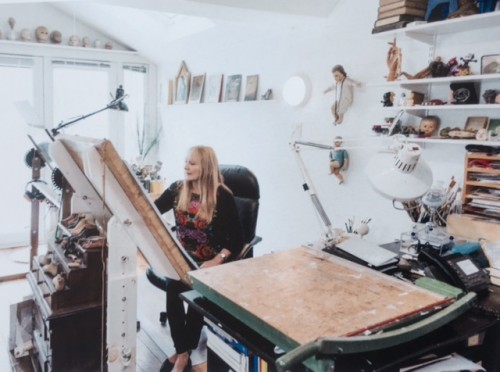 Photographed in her studio in Cabbagetown, Toronto, March 2016. While she’s still a sought-after artist, Kunz says she’s had to adapt her strategies when it comes to getting new work. “There are a lot of great artists out there; there just isn’t the work that there used to be,” she says. “I wish I had the jobs that I used to turn down. There was so much work and so many fewer artists.” Right opposite her drawing board, Kunz installed a wall-mounted TV set to stream CNN. Some artists would consider that a distraction. For Kunz, it’s food for thought.
Through the 1980s and 1990s, Kunz rode the celebrity culture wave doing portraits of Hollywood actors and monthly end papers on the history of rock and roll for Rolling Stone. She also drew over 50 book jacket covers and took on the occasional advertising assignment for beer brands and chocolate companies, although working in advertising was never her goal, even if the money was amazing.
September 11, 2001 changed everything, but for illustrators it hit the tone and volume of their assignments. Before that, you could be more biting and controversial in print, says Kunz. “Darker work was being widely published.” She points to the moment President George W. Bush declared, “You’re either with us or you’re with the terrorists” as the turning point when political commentary and satire practically evaporated, with The New Yorker being the only exception.
Since then, the aftershocks of 9/11 have been replaced in publishing by the pain of a broken advertising model that has drastically reduced the power of print, scattered readers across the Internet and forever changed the way all commercial illustrators must work. “In the old days, we would enter the awards annuals or buy a page in Workbook or Showcase and sit back and wait for an art director to phone us. But very few of us rely on commissioned work anymore,” says Kunz. “That strategy is obsolete.” Instead, everyone now is focused on self-generated work. Kunz has even taken to calling herself a “content provider” for the print publications that are left.
With a wall of awards to her credit—including Officer of the Order of Canada, the Queen’s Diamond Jubilee Medal, honorary doctorates from OCAD University and the Massachusetts College of Art and Design and now a Golden AACE Image Award—the biggest highlight of Kunz’s career is still the opportunity to travel the world, including a jaunt to Spain last fall where she met up with her pal, Ralph Steadman. “I never saw travel as being part of my job. I thought I’d just be in my studio working away,” she says—but Kunz gives workshops, lectures around the world and regularly attends international cartoon conferences. “Just being able to see how artists work in other countries [is really eye-opening]. Through my travels, I’ve met artists from Iran, China and Cuba and they’re so amazed by our [autonomy and] freedom of speech. It’s something most of us take completely for granted.” But not Kunz.
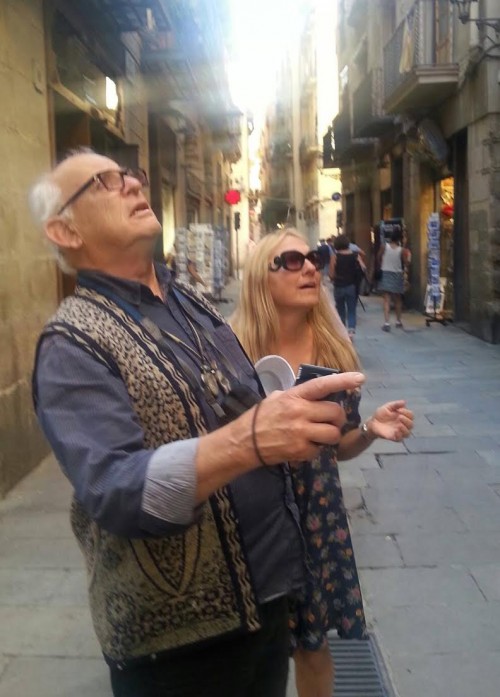 Anita Kunz and Ralph Steadman overwhelmed by the beauty of Spain.
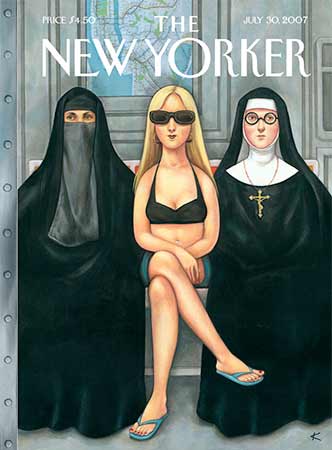 “Girls Will Be Girls,” The New Yorker, July 30th, 2007. “The covers editor at The New Yorker is Francoise Mouly,” says Kunz, “and she’s married to the artist, Art Spiegelman [of Maus fame]. Mouly is amazing to work with. Like most French people, she loves comics, cartoons and all kinds of art, and she makes sure that she uses a lot of women illustrators. Diversity with her artists is a big deal. I’ve sent her all kinds of stuff that I know will never make the cover, but she’s really open to pretty much everything. And she never censors me at all.”
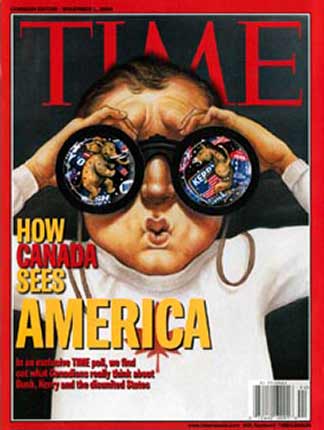 “How Canada Sees America,” Time (Canadian Edition) Nov 1, 2004: “It used to be that there was a hierarchy of magazines and if you did a Time cover you were the best artist. But now, with the Internet, it just works in so many different ways to get your work out there and it isn’t as binary. That’s one of the biggest changes from 20, even 10 years ago.”
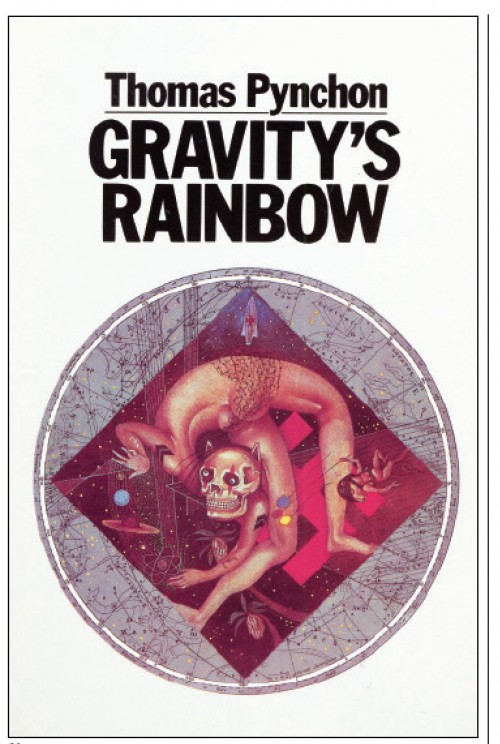 Gravity’s Rainbow by Thomas Pynchon, 1984, Picador Books: “This was one of the most complicated books I ever read, and really hard to get the germ of the idea. Pynchon kept going off in tangents. I mixed up the art the same way the writer did and made an image that can be read in all directions.”
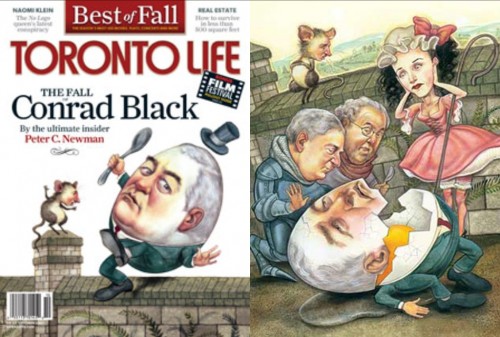
“The Fall of Conrad Black,” Toronto Life, Fall 2007: Kunz often uses word associations and lateral thinking to find ways to visually explain events in the news. She especially likes to refer back to older works in literature or art history to give these events a context. To wit: Conrad Black as Humpty Dumpty having a great fall, Lance Armstrong as Pinocchio riding a bike and Trayvon Martin as Munch’s Screamer in a hoodie.
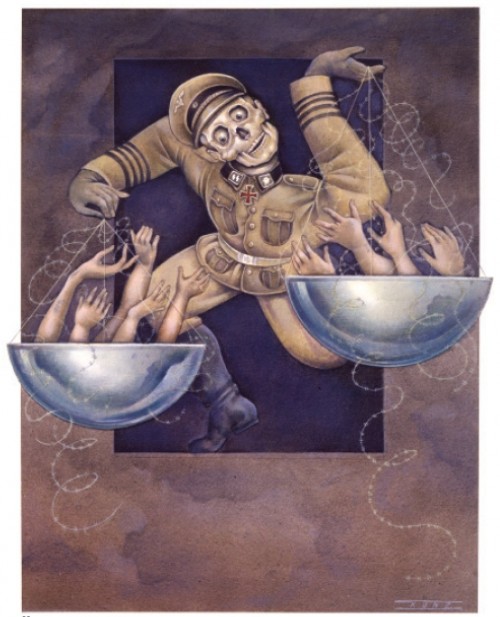 Helmut Rauca, Saturday Night, 1982: “The Rauca piece was one of [my first significant] assignments. The angle of the article was, there’s a monster living among us and no one has ever done anything about it.” Rauca was an S.S. Master Sergeant during the Second World War who moved on to a quiet life in Canada.
A version of this article originally appeared in the June 2016 issue of Applied Arts Magazine.
Drop cap by Jessica Hische, courtesy of Daily DropCap.
May 17, 2016
It’s easy to confuse productivity with creativity. In my latest animated video, I “asked” Maria Popova and Pearl Buck to explain the difference.
Sources
Maria Popova, “Creatively Juiced,” The New York Times Book Review (April 10, 2016).
Pearl Buck, 1938 Nobel Prize Speech.
Music: “Layback” by Alan Jones (purchased on Shutterstock.com)
Built on the awesome Wideo.co platform.
April 30, 2016
April 13, 2016
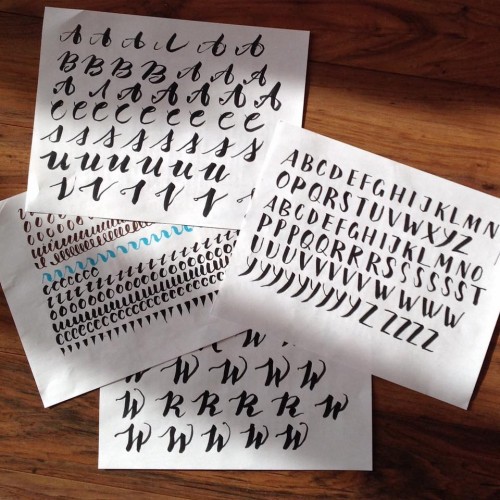 My favorite kind of homework. Hardest letters: S, Y. #brushpenlettering #brushguide (h/t to our teacher, Miami-based art director, Andrea Campos)
It’s no contest. Given the choice between, say, Scarface and a tutorial on brush pen lettering (above) or a primer on watercolour techniques, I’m going with the loaded brush.
I think Skillshare is one of the biggest gifts the internet has to offer.
Everything I could possibly be interested in in the realm of art, letters and digital technology is represented. The videos offer a homespun look at process and invite you to sit desk side with your talent crushes. Yes, you get to study the tchotchkes on and above their desks.
I gave up my Netflix subscription four years ago, and while I’m open to switching it back on, I’m much happier listening to Debbie Millman talk about visual narratives or watching Andrea Campos demonstrate the hand pressure you’ll need to create fluid upstrokes and downstrokes with your Tombo Brush Pen.
The very best of the human spirit is gathered at Skillshare.com.
Check it out. I’m guessing you’ll be drawn to the light too.
March 19, 2016
A Seth Godin blog post called “Reject the Tyranny of Being Picked: Pick Yourself,” published in March 2011, made the rounds on the internet again this week. And with good reason. (h/t to Gapingvoid cartoonist Hugh MacLeod for reviving Godin’s greatest hits in his crunchy daily email).
To recap, in March 2011:
In 2016, the digital economy has finally rolled over these decimated print media outlets, forcing mass closures and mergers with more closures to come. Channel-based TV and radio divisions (and their terrestrial stations) are also collapsing like sandcastles (CBS, BBC) as the brands go digital.
Translation: Godin’s discussion around the fall of gatekeepers in arts and culture is no longer a prediction but a full-on reality.
I leave you with Godin’s plea to entrepreneurs, artists and bloggers. Your ability to feel hopeful depends on your mindset and capacity for change:
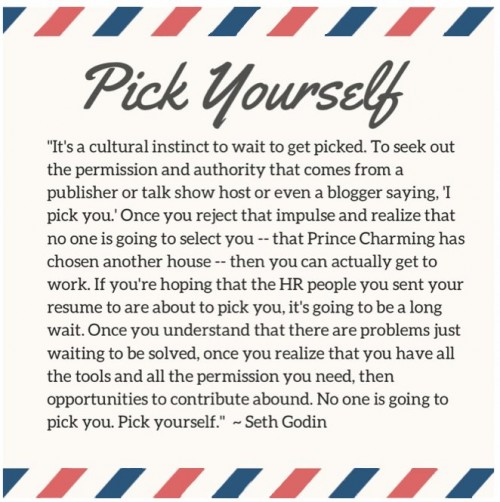
Godin adds, while you’re working and doing your thing, “You will not feel safe, you will not feel like everything’s going to be OK. There is no amount of reassurance that’s going to help you [get past the doubt]. The hard part is doing work precisely because it feels like it’s not going to work. Living in two futures at once: the future of ‘it might not work’ and the future of ‘it might work’ at the same time is at the heart of what our economy is demanding from us.” (this quote is from Mitch Joel‘s interview with Godin from the end of 2014).






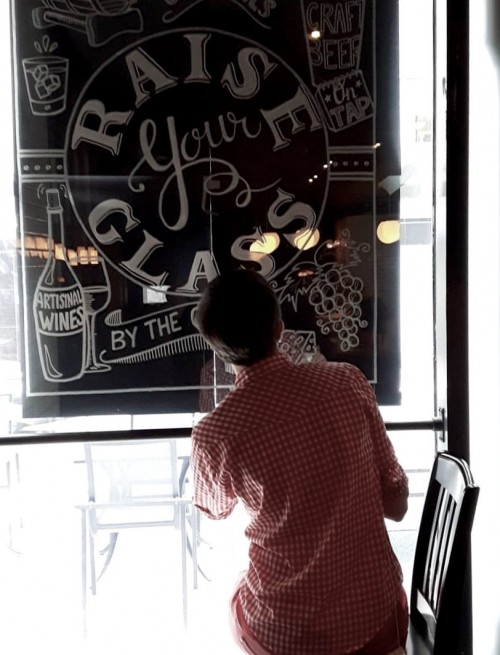 Doing more of what I love at
 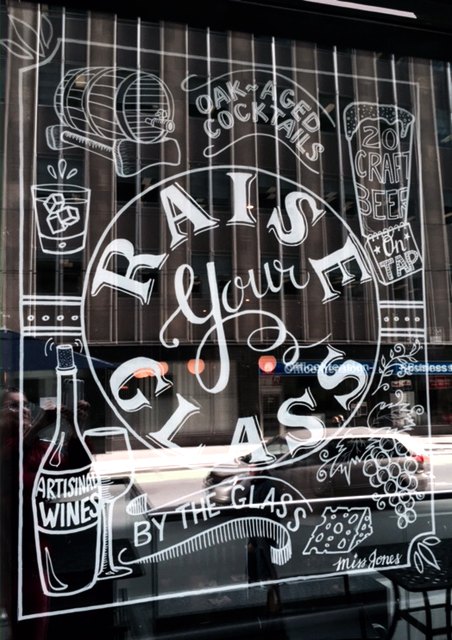 The results!