
“The imagination of change has to always precede the reality of change.” ~ Gloria Steinem
Words and illustrations by Alison Garwood-Jones – ©2014




November 21, 2014
“The imagination of change has to always precede the reality of change.” ~ Gloria Steinem
Words and illustrations by Alison Garwood-Jones – ©2014
November 20, 2014
As a teen, I spent hours making hyper-realist drawings from magazine ads, Old Master works (some Old Mistresses too, like M. Cassatt and C. Claudel), and anything else I could get my hungry hands on. Despite a few interruptions (jobs, diminished metabolism, rattled teacups), the plundering continues.
#PlayTime #WaysOfSeeing #PlunderCulture
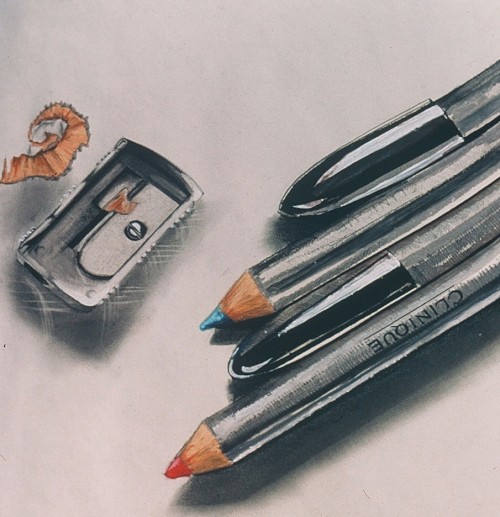 My 17-year old self did this. Photo: Trevor Garwood-Jones
November 3, 2014
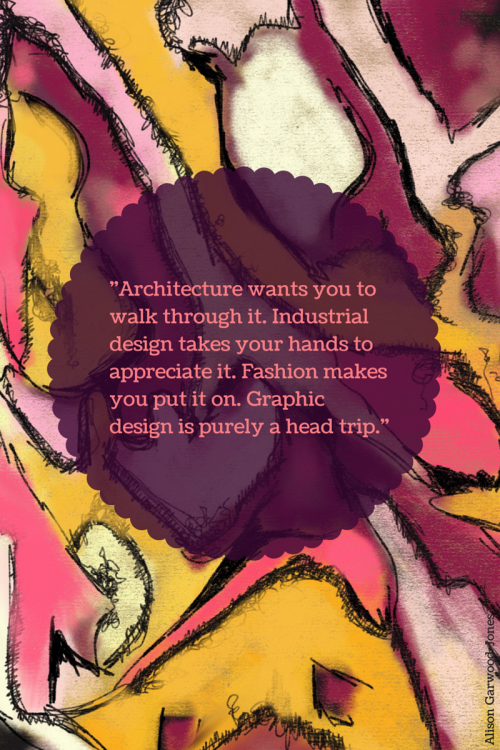
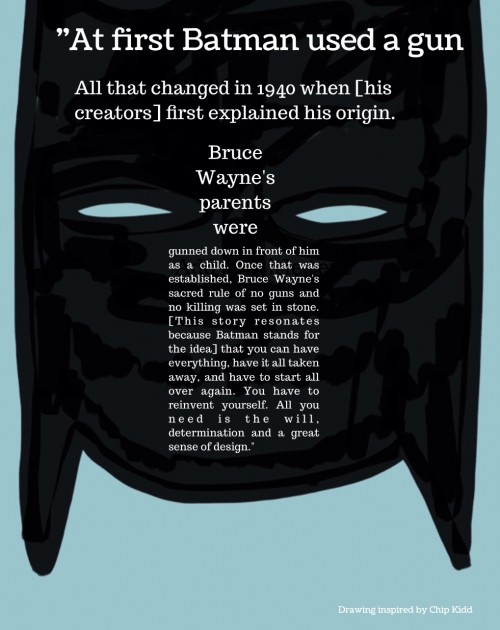
My favourite quotes from Chip Kidd’s most recent book, Go: A Kidd’s Guide to Graphic Design. He’ll get you thinking. Thanks Chip!
.
.
.
.
.
October 3, 2014
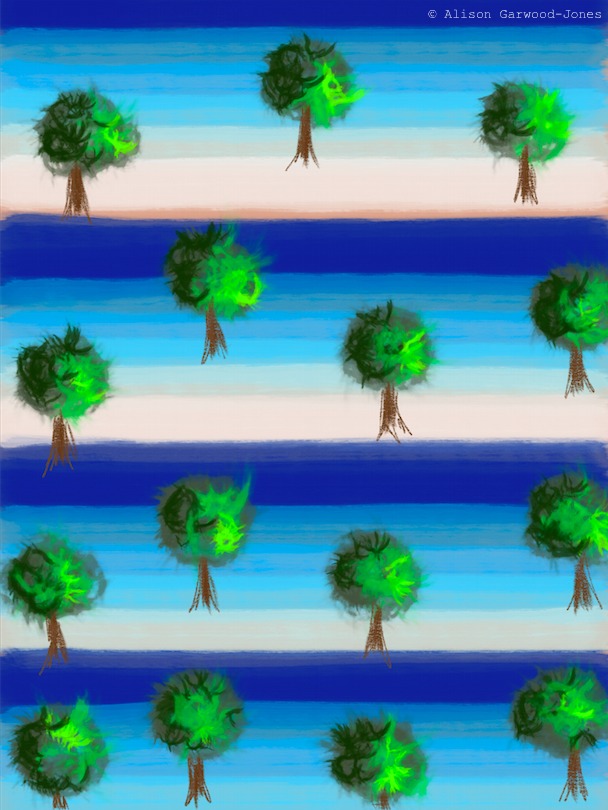
Pattern is a way of re-ordering the world and your emotions into something more beautiful and understandable. It’s why we make art.
It’s why standing under a maple tree and looking up feels so good. I’m looking for a blazing red one this weekend.
September 28, 2014
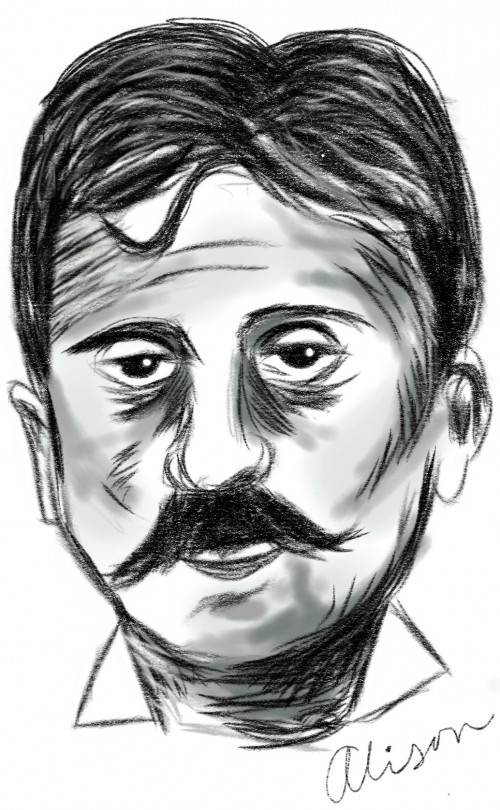
Marcel Proust (above) defined deep reading as the moment when,
“That which is the end of [the author’s] wisdom appears to us as the beginning of ours.” (1906)
Book editor Peter Dimock took it one step further, calling deep reading,
“A time of internal solitary consciousness.” (2010)
Neuroscientist Maryanne Wolf, author of Proust & The Squid, pulled these quotes together in an article for “Nieman Reports” on reading in the digital age.
My friend Jonathan Menon, a fellow writer and loyal reader of this blog, kindly pointed me to this and several key sources I couldn’t find during the writing of my last blog post. Thanks Jonathan!
To recap: in my last blog post, Warp Speed, I tried to describe why I thought a balanced diet of breathless internet search and solitary deep reading (on paper) was essential to my happiness, sanity and the continued good health of my intellectual curiosity. If you feel the same way, I recommend printing out and studying the following articles:
• “Your paper brain and your Kindle brain aren’t the same thing”
(This article is based on a radio interview by Manoush Zomorodi, managing editor and host of WNYC’s New Tech City, with the Washington Post’s Mike Rosenwald. The podcast is embedded in the article)
• “Paper beats computer screens”
• “The Reading Brain in the Digital Age: The Science of Paper versus Screens”
September 24, 2014
My favourite moments in Star Trek, the original series, weren’t the fight scenes where scrums of Beatle-booted characters threw fake punches and ricocheted off walls with a little too much actorly enthusiasm. And it wasn’t when Spock grew a beard and waxed poetic about the universe. And it certainly wasn’t when Kirk fell in love. I got embarrassed every time the lens misted up and the Stratford-trained captain pursued his next interplanetary go-go dancer. No, I liked it best when we looked past the back of Captain Sulu’s head, through the modest windshield of the Starship Enterprise, and experienced the onslaught of an oncoming asteroid field.
I’d say that those Star Trek sequences, plus the opening credits where the ship zooms away at warp speed, were my first experience moving through infinity. Even on a crummy black and white Zenith TV those simulated navigation scenes gave me a mini head rush. Not bad for 1966 special effects! It wasn’t until 1977, and the premiere of Star Wars on the big screen, that I experienced an even stronger white knuckle adrenaline rush through the windshield of the Millennium Falcon, with a young Harrison Ford at the controls.
These days my screen has shrunk back down to 15 inches, but the feeling of infinity I get looking out on cyber space is part joy ride/part mournful bargain. Here’s what’s fun: my cockpit has an external drive hooked up to Time Machine, a backup mechanism that unfolds like a sci-fi episode I like to call, Found In Space!
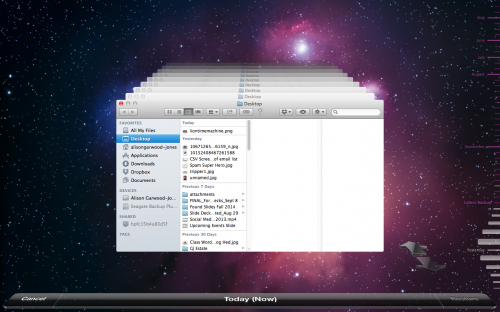
Moving your cursor over the Time Machine screen takes you through an accordion file of past desktops (above). There they are, floating in zero gravity against a gassy, star-studded universe. I get my “star fix” from that.
But even with my knowledge of space travel limited to the imaginative outpourings of Gene Roddenberry, George Lucas and the engineers at Apple, I’ve come to a few conclusions about navigating cyber space vs. the cinematic presentation of space:
• In cyber space, the endless expansion of ideas and junk, year over year, feels like a smaller version of the Big Bang that created the universe. The latter posits that a galactic “explosion” took all matter from one place then flung it outwards in every direction, never to stop moving. But here’s the thing: watching fake asteroids whoosh by on a movie screen is way more fun than the head rush/ache I get watching books explode and words and letters zoom past at warp speed across my screen.
• The idea that pixels unsteady us, visually, is accepted as fact. Web developers, like John McWade, will tell you that this elusive physical sensation is due, largely, to the fact of there being no reliable print to web pixel per inch (ppi) conversion. When you take something from print to digital, says McWade, you need to take into consideration multiple ppi’s, screen responses and even screen colour temperatures. All too often, developers never get it right, especially when they are trying to configure the same thing across desktop, tablet and mobile screens. These limitations are making our heads and eyes swirl. But I also think our emotions are getting sucked into the optical black hole .
• We still need to understand the psychological effect of shaky visuals and bottomless speed reading that’s loaded down with multiple side routes to social media. The only way to steady ourselves may be to reintroduce a healthy balance of paper back into our lives at the same time we continue to delve deeper into technology. When we do, books will become intellectual havens and sandboxes instead of medieval word delivery systems. This argument runs parallel to those calling for a reintroduction of solitude and absence in our lives. “You can’t think of a new or game-changing thought if you’re living in an echo chamber,” Michael Harris, author of the book The End of Absence, told Nora Young in a recent episode of Spark. “You have to remove yourself and carve room for absence.”
So, despite the endless possibilities available to me from my keyboard, including the entire Library of Congress (I haven’t touched it, have you?), I keep coming back to the emotional significance of words designed to be at one with a surface they’re on. Words are the not only thing at one with the page, so am I. What’s more, pages corralled between two covers don’t fence in my imagination, they offer a platform on which to leverage my imagination even further afield.
This is only a guess, but I’m thinking that when our eyes and brain detect the physicality of ink on paper, it sends a different message to our brain’s emotional core, one that tells us we are standing on solid ground. That physicality, combined with the absence of social media sharing buttons, sets me up to relax, absorb and really think. There must be studies published that say this. Maybe I’ve read them? I just haven’t found them in time for this blog post. Please share if you know of any.
Finally, I love the feeling of being at one with a writer. I’ve had it reading Alice Munro, Daniel Boorstin, Billy Collins, Robert Fulford and many others. I’m a better person because of that. But this breathless rush of digital culture is shrinking my sense of self, as far as I can tell. It’s certainly shrunk my memory muscle. I’m re-engineering my life to fix that. It starts with holding a book.
Captain Kirk left these behind.
September 12, 2014
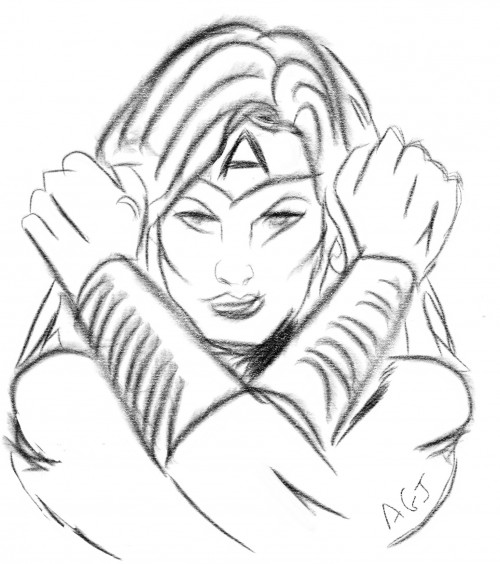
I had a great summer. My blog? Not so much. For three months, it was bombarded by a spam attack so thick and persistent that a team of developers had to put down their swords so they could scratch their heads.
We ended up having to switch commenting platforms (the source of my woes) and settling on Livefyre. Intense Debate is toast.
My thanks to Graham Scott and Danny Brown for their advice. And a very special thank you to Kathryn Barlow of KBarlow Design for clearing out and deflecting all future spam. She was as tenacious as Wonder Woman.
I’ve really missed using this space to write and draw. LinkedIn Publisher is good, but nothing beats posting on real estate you own.
Here’s to a great fall!
Alison
July 31, 2014
When my story pitches for magazines or newspapers tank, it’s usually because:
1. My story idea is lame.
2. The story is good, but my pitch sucks.
3. My editorial connections are too thin.
4. It’s already been done (and, tut tut, I should have known that).
5. It’s a good pitch, but the wrong magazine (and shame on me again for not studying more back issues)
I’m starting to think that none of the above applies to a story idea I’ve been sitting on for months. A producer/documentarian I was introduced to last fall is working on the first ever interactive documentary specifically formatted for the iPad and she wanted some coverage in legacy media. The story is cool, she’s cool, and the whole package has tons of “Now” and “Wow.” But every Canadian and U.S. magazine I pitched either said, “Yeah, maybe” (and never got back to me), or they said nothing at all. Even when I pitched it as an online news feature.
While I was waiting for editors to bite, I followed how the documentary was coming along on social media — it’s debuting in October both on TVO and via a an app — and I think I finally know what’s wrong with my pitch: this story doesn’t need me.
At the same time I was interviewing this talented documentarian in coffee shops and at her home office, she was overseeing a campaign of regular and highly engaging tweets, blogs, video teasers and Facebook posts, leaving no stone unturned about her challenges and incremental victories. I tried to find angles that she hadn’t covered, but the moment I thought of one she wrote about it. So here I was competing with my subject for scoops! Did I resent her? How could I? I loved what she was doing. Showing your progress online is how you gain support, traction and publicity for a project. Holding your cards to your chest and being all secretive until the big reveal is so old school.
What I’ve learned from this experience is that the challenges facing legacy media aren’t just about advertising and switching to new distribution channels, they’re also about accepting the changing nature of exclusives and the rise of DIY storytelling. For the first time in my career, I knew what it felt like to be the “middleman” between a subject and her work. And we all know the fate of middlemen in the internet age (just ask the music industry). Even PR people have slowed down brokering relationships between journalists and clients. Now they are spending more time coaching brands and startups on how to become the hubs for their own storytelling. Martin Waxman, one of the smartest people I know in communications strategy, said it best,
“These days it’s not enough to be in the news, [startups and brands] need to create, produce and share it. And in order to do that you need to think like a newsroom and amplify stories via social and digital channels.”
I’m still hovering over the “think like a newsroom” part. I met Martin when I was an editor at Elle and he was the head of a PR agency that handled many big-name beauty accounts. I wrote a lot of service-style journalism based on the stories Martin and his team shared with me. Martin abandoned old-style PR, however, the moment he clued in to the power of social media. He adapted to the new landscape way, wa-a-y earlier than most of his colleagues, many of whom were still stubbornly advising clients to stick to a broadcast model of communication — you know, the old “spray and pray” approach. Now Martin is showing brands how to ditch the press release and be their own storytellers. “Start on the inside with a publishing strategy, an approach to content that’s based on what you do better than anyone else,” he told a crowd in Las Vegas last week at the SXSWV2V conference for startups and innovators.
After I left Elle, I my output of service journalism — what today we call “sponsored content” or “brand journalism” — slowed down to nothing as I set my sights on writing more stories about culture, technology, design and human nature. The thrill of writing advertising copy was short-lived for me. That’s why I’ve never had a problem with brands taking over their own storytelling or pulling former journalists into the fold to push out their content, so long as those former journalists only write sponsored content and don’t straddle between that and covering hard news (another post entirely).
But sponsored content isn’t the only storytelling switching hands. Now the stories that are really worth telling, stories of human innovation and stories about people’s struggles and triumphs, are becoming harder to place in magazines as the number of voices telling those stories multiplies.
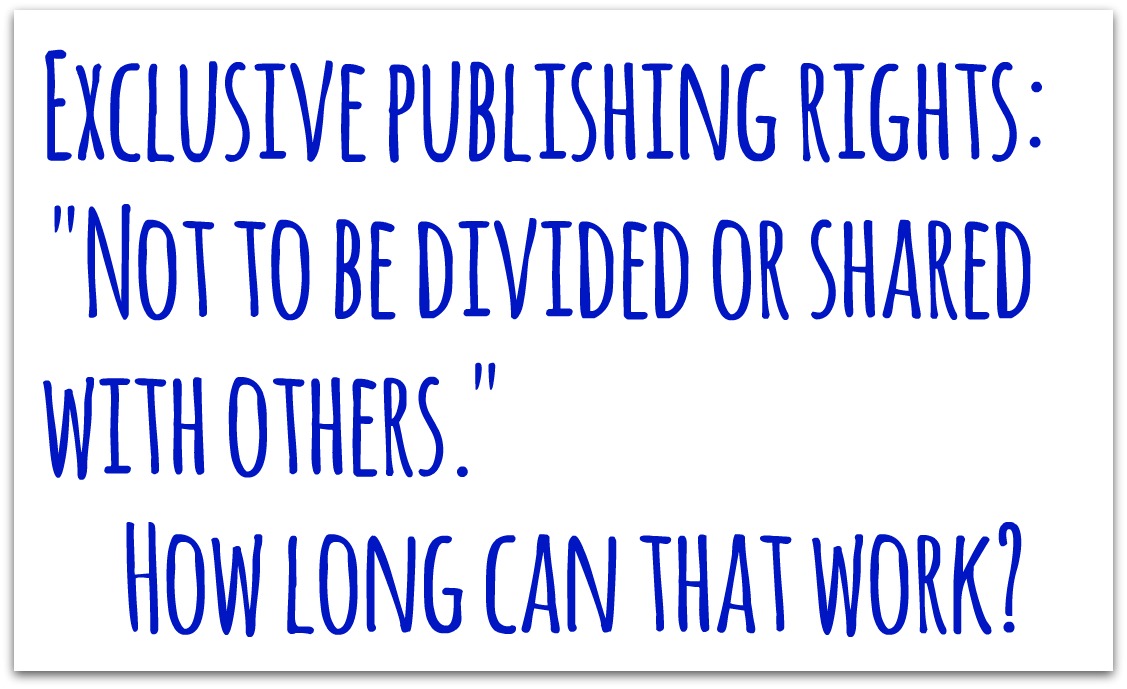
The predictions were long in coming and I’m finally bumping up against legacy media’s stipulations about lead times, breaking news and exclusives, all of which are totally at odds with the sharing, slicing, dicing, repurposing, in-progress (“Open File”) spirit of online storytelling. I mean, here’s the definition of exclusive publishing rights: “Not to be divided or shared with others.” How long can that work? And are magazines going to keep turning down stories just because the people at the centre of the story have been blogging and tweeting about their work from its inception?
The internet has changed our relationship to the history of ideas. I don’t know how magazines will adapt to that. Maybe it doesn’t matter. I’m in another headspace now: the open, freeform world of blogging and updating.