




Alison Garwood Jones

I vant to be alone

January 30, 2012

Groupthink is one hot topic that leaves me cold.

I’ve worked at magazines where I had my own office and ones where I sat in the middle of a bunch of cubicles. I think I was at Windowpane No. 4 at Elle. We were on the fifth floor in an open concept and instructed to keep our blinds down all day lest a bird thought of dive bombing our desks.

While the building management was saving wildlife, the occupents inside were withering away from the lack of natural light, fresh air and the sound of silence.

Looking back, I wasted a whole lot of creative energy trying to block out the sound of other people’s phone calls, tape recorders and desk-side chats. I don’t think noise-cancelling ear phones were what the cheerleaders of colloboration had in mind. I never bought a pair — I didn’t have the nerve — but I thought about it all the time, and wasted even more energy pretending to look like a fashionable team player.

I got my best ideas sitting on the toilet — that is, until a co-worker came looking for me.  “Do you have cramps?” Yeah, brain cramps. I dragged myself back to my desk.

Shania Twain came up with her best hooks sitting on the forest floor in Northern Ontario, in and amongst the tree roots and fallen pine needles. She bristled when producers ushered her into the designated “writing booth” inside her label’s Nashville recording studio.

The most creative solutions in any field spring from solitude, not through nattering co-workers, needy technology and closed architectural settings.

Here’s one of my favourite essays on the subject written by Lisa Rochon, architecture critic for The Globe & Mail.

I think we already know the solitary truth about creativity, but I’ll bang the drum again.

Zen and the art of creative architecture

By Lisa Rochon

The Globe and Mail, Saturday July 4 2009: R7.

One of the biggest misconceptions out there is that all work takes place at the workplace. The truth is that the big ideas, the really bold experiments, are hatched outside the conventional office. Ask an architect where the fundamentals for a design are drawn, and learn about vast quantities of sketch paper floating through the cottage, the bedroom, even airplanes.

Funny, but the most potent ideas belong to simple, almost primitive spaces and pleasures. Le Corbusier often retreated during the month of August to Roquebrune-Cap-Martin, a village perched on the edge of the Mediterranean, where he designed monumental buildings and new urban districts in a wooden hut and wearing a bathing suit. He kept small animal bones, inspiring to him for their organic form, in wooden fruit crates.

Raw, creative freedom is what many architects seek. To drill down to his deepest intuition, Britain’s Will Alsop paints in a shed at his family’s country home on England’s northeast coast. Toronto architect Janna Levitt says that when a design problem needs critical attention, she may suddenly wake up at 2 or 3 a.m., gaze at a painting by Norval Morrisseau for strength, and then draw for a few hours.

Bruce Kuwabara finds myriad sources of inspiration – including concerts at Roy Thomson Hall – adding that “the serious work is either at home alone, or at the office on a weekend. I’m just basically by myself at an empty table … I use China markers – you don’t sharpen them, you unravel them from one end. I like them because you can’t express any detail with them. They deny detail. They get the fundamental things.”

The retreat into the creative mind is often described as a stolen moment. But, from what was it stolen? From the banality and harassment of technology? From long-winded conference calls and circular conversations at team meetings?

For Meg Graham, principal of superkül inc. architect in Toronto, there is the quiet pleasure of drawing, on her own, at cafés and restaurants. “I often feel like I’m stealing time,” she says, “which makes it all that much sweeter a pleasure.”

Then there are the times during weekends when Graham and her partner, Andre D’Elia, find design clarity without the noise of phones and e-mail alerts. “We sit across from each other, each with our own clutch of pens, either in the office at one of our work tables or in our apartment, sitting on the ground at the coffee table in the living room.” This is how their award-winning 40R Laneway House in midtown Toronto was born, at their coffee table, with vast quantities of sketch paper strewn around.

Many architects (the late Arthur Erickson, Moshe Safdie) have used the airplane as a coveted place of stream-of-design consciousness. [IT’S ALISON AGAIN: IF I CAN ADD, MY DAD SAT NEXT TO ERICKSON ON A FLIGHT ONCE AND ARTHUR NEVER LOOKED UP. HE SPENT THE ENTIRE FLIGHT (TORONTO TO VANCOUVER) SKETCHING ON SCRAPS OF PAPER]. Toronto architect and artist Paul Raff has found much inspiration for ways to sculpt light with architecture by watching and photographing clouds seen from a plane. After studying a site and walking through it over a couple days in Phuket, Thailand, Raff designed a series of resort villas – faced in bamboo and delicately sited on a steep jungle site – during the 24-hour trip back to Toronto.

But Raff also finds creative Zen moments while sitting in his Spadina Avenue studio. That’s where he happened to glance at a series of glass samples stacked on his windowsill – and was inspired by the reflection of light to create a glass screen suspended in front of the living room of a Forest Hill house; it was subsequently honoured with a design excellence award by the Ontario Association of Architects. Raff’s sister company, RVTR, with Kathy Velikov, Geoffrey Thun and Colin Ripley, was awarded the Canada Council for the Arts $50,000 Professional Prix de Rome in Architecture last week.

Why don’t the people who run our offices and factories build a little blue-skying into the daily regime? The North American boss looks around his workplace and smiles at the way the employee gobbles lunch without even looking up from the computer. Meanwhile, in Copenhagen, offices with more than a couple dozen employees are legislated to provide a fully catered lunch in a dining room. The Danish architecture firms I visited recently, including Lundgaard & Tranberg, BIG and 3XN, were serving roast beef or salmon, hot dishes and cold, and the lunchrooms were airy and colourful. Served up daily: not just a healthy midday meal, but a great milieu for exchanging creative ideas.

This is something that Montreal architect Gilles Saucier practises daily – eating out at a restaurant with his partner, André Perrotte or clients, where some of the best design ideas are exchanged. Hygge is a Danish word, badly translated as “cozy being together” and better understood as something ethereal that has captured the right mood, the perfect atmosphere; or, as Toronto architect Donald Chong puts it: “Hygge is everything you didn’t realize you were after.” For Chong, when there’s hygge, he can come down to first principles of design. “It’s me and my pen and my notebook. I don’t have to be plugged in. I don’t want to be on the Internet. I just want to rely on my head and my hands. If I can do that, then I’m good.”

Is it wrong to work while lounging in bed? Too often, Canadians armed with a punch-the-clock and sit-at-your-desk mentality would scoff at such a notion. But French superstar designer Philippe Starck has produced countless concepts for hotels, housewares and furniture from his bed. The mediocre ones go in one basket; those worth pursuing are thrown in another.

A confession here: The idea for this column was not generated at my desk. It began about two weeks ago when I found myself walking along a winding path through a paper-birch-and-pine forest in central Finland. It was the path Alvar Aalto walked to get to his Experimental House (1954) on the island community of Muuratsalo in the middle of Lake Paijanne.

Travelling through leaves and over rocks, I imagined how walking the path helped transport the legendary architect away from the pressures of running his office in Helsinki to a more liberated state of mind. I passed by the 10-metre-long pine-and-mahogany boat he designed, called Nemo propheta in patria (No one is a prophet in his own land), a vessel he often took out to the lake in order to study the visual impact of his courtyard cottage and the island forest. Along the edge of the lake, I encountered the robust smoke sauna that Aalto created as a muscular log structure and a mono-pitched roof. This is where city life would have been sweated out.

From the path, the summer house stands out as a surprisingly bright-white angled form rendered in brick. What begins with the promise of white modernism changes dramatically around the corner, where the bricks are deliberately opened like an eroding ruin to provide views into an atrium courtyard. This is where the house reveals itself as a place of steady, creative experimentation; Aalto was an architect who tested new ways to build. Wanting to reject conventional systems of creating foundations for the summer house, he devised a diagonal one of beams laid directly on the rocks embedded in the moraine ridge.

Inside the courtyard, dozens of patterns in ceramic and brick are laid up the walls and arranged in a variety of ways for the courtyard paving. Aalto itemized his experiments: normal brick on edge; narrow bricks end upward; Riihimaki tile, reverse side up, grooves against the earth; Riihimaki tile, right way up, darker.

If all of this sounds like a lot of work, maybe it was. But, it was done with a clear head and a full heart in the Nordic forest. As Aalto once said: “Between swims, I can work completely in peace.”



Comment on this post »

Show me the money: Part deux

January 25, 2012

For all you old-school print journalists still wondering how to make a buck from blogging, here’s how it works:

Editor sees your McSweeney’s post reposted on Facebook (you’re not even friends … yet), and says,

“Oh my God, I own a print of “Poster Making” (a.k.a. the FUCK OFF poster).

She purchased it at the Paul +Wendy Projects, and still hasn’t hung it.

Editor calls you to discuss the serendipity of it all, and how we may have gone to the same hairdresser three decades ago.

Editor segues into giving you an assignment.

That editor is Catherine Osborne of Azure Magazine, a hub for architecture geeks, and whose title is named after the colour of the sky.

Here is a portrait of her from LinkedIn:

Hopefully not … THE END

For my first post on blogging and making money, click here.

Comment on this post »

In conversation with Royal Art Lodge

January 23, 2012

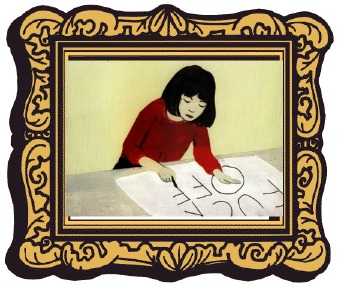
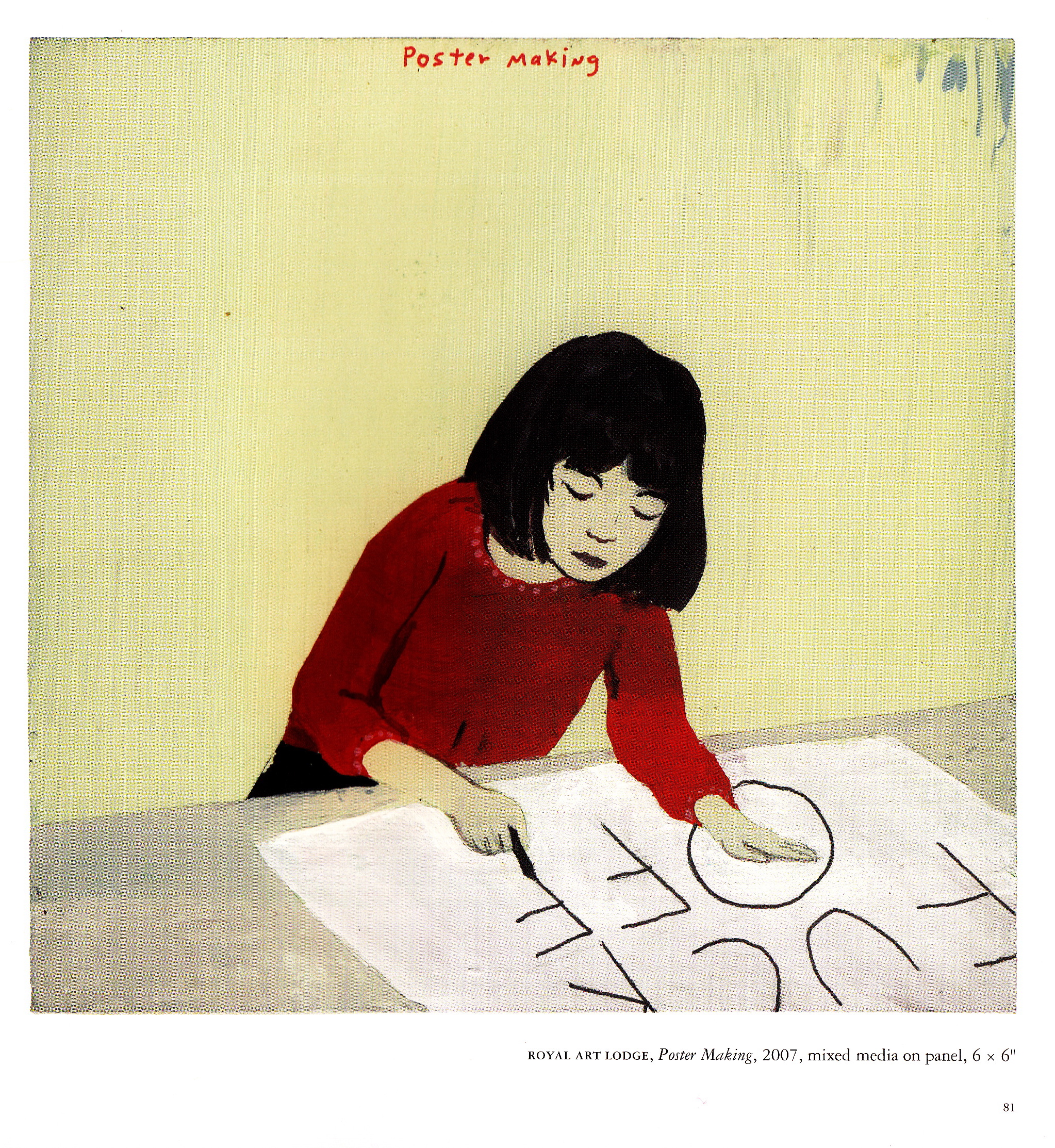
How did I go from this?

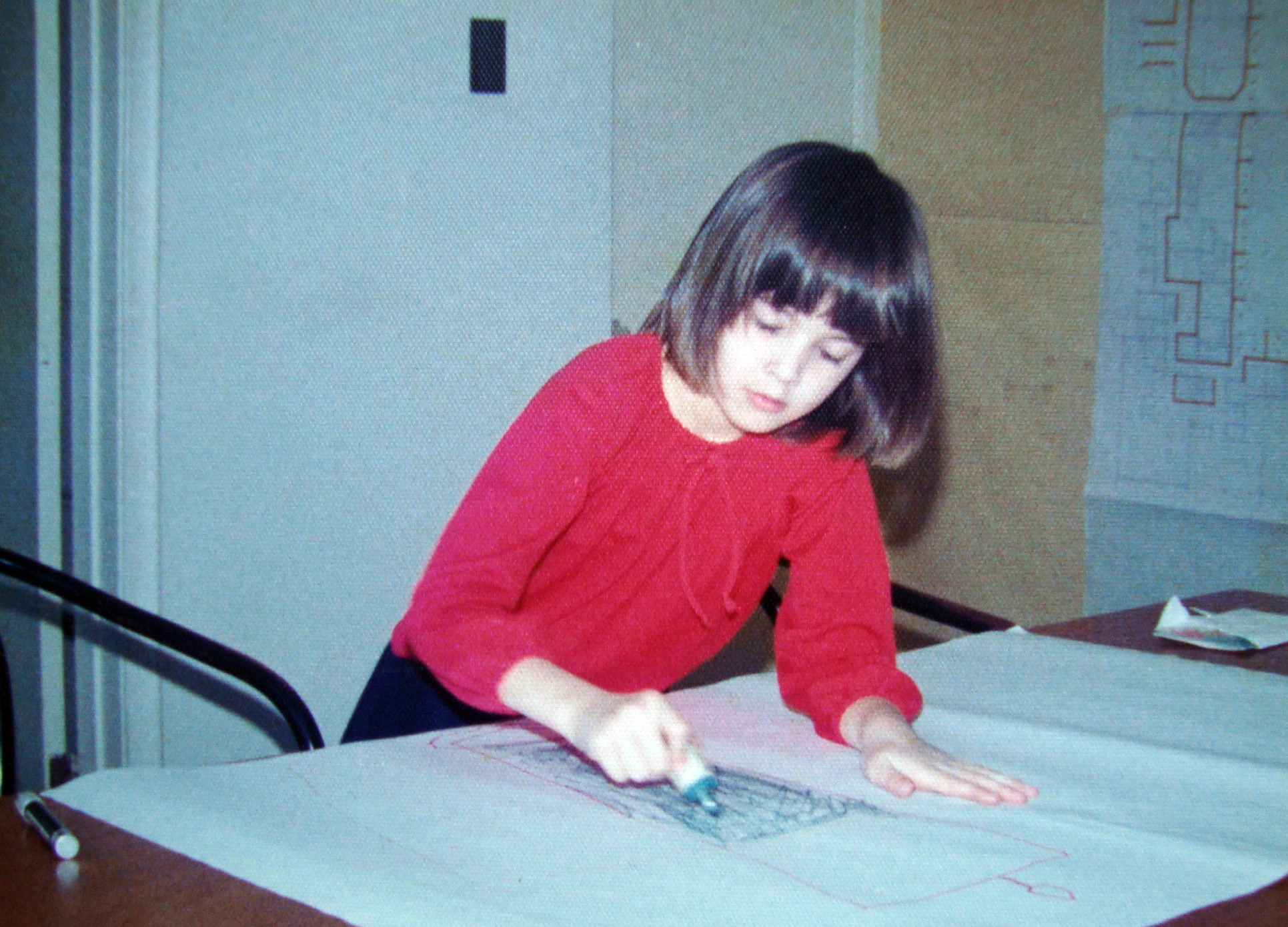
To this?

Royal Art Lodge, Poster Making, 2007, mixed media on panel, 6×6″

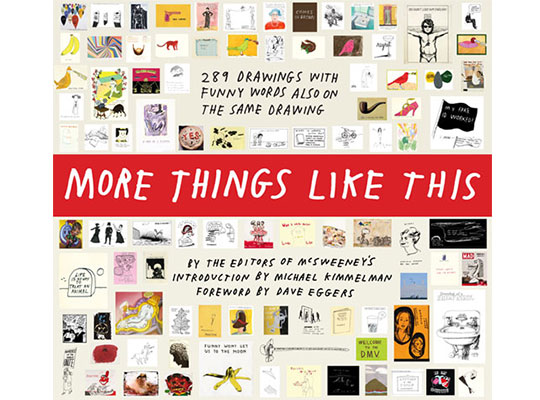
To recap: Last week I was randomly flipping through the book, More Things Like This, a loot bag of art and musings curated by the editors of McSweeney’s, when I stopped dead in my tracks because I recognized myself in one of the paintings. Here’s the story and some of the folks who flocked to it.

The work, by Royal Art Lodge, a hip and now defunct art collective from Winnipeg, shows a little girl writing “FUCK OFF” on a poster board.

Neil Farber and Michael Dumontier, the men of Royal Art Lodge, heard about my brush with serendipity and sat down for a chat about art, life, process, and inspiration. The two continue to work together, exhibiting their art in galleries around the world and garnering praise in publications like The Paris Review. Their book Constructive Abandonment was published by Drawn & Quarterly last spring.

Alison GJ: I was right, you found my photo in a back issue of Elle Canada [I was an editor at the magazine, and, one year, the staff presented the art director with our kid pics and she turned them into a collage for a holiday issue]. The Royal Art Lodge was all guys, so what were you doing looking at Elle Canada, LOL?!

Royal Art Lodge: At the time that painting was made we were three guys [Neil, Michael and Marcel Dzama], but for much of our history we had one female member, Holly Dzama. We often used, and still do use, fashion magazines as reference materials. We paint a lot of women.

AGJ: What drew you to my picture in particular?

ROL: Children are one of our favorite subjects for painting and that is a great photo. It’s possible that we painted some of the other cute kids as well. Michael Dumontier actually painted the image in that one and Neil wrote the caption.

AGJ: Your bios at the Richard Heller Gallery site characterize your paintings as combinations of “innocence with a complicated and often foreboding sense of the absurd.” Can you describe the imaginative leap that took you from my pic to this painting?

ROL: Michael would have painted the picture and set it beside all of our other “unfinished” paintings. I probably never saw the actual photo, so my relationship was just with what Michael had painted. I think the focused expression in the photo is key to making the painting work. She seems careful and sincere.

AGJ: Yup, that sounds like me. What story are you telling in this painting? Little girl writes, “FUCK OFF” ….

ROL: To us, the painting is about language. The plain description of her activity as “Poster Making” is set against the fun image of a little girl carefully making a vulgar sign. It kind of mirrors the comedy of a dry journalist reporting on a funny situation.

AGJ: Did you imagine the girl heading off to a protest or something?

ROL: No, we just imagined her making a poster to hang on her bedroom door.

AGJ: Is there supposed to be a “Network-like” anger bubbling beneath the surface of this work? You know, is your waif as mad as hell and she isn’t going to take it anymore?

ROL: No, we don’t see her that way. In the later Art Lodge works we were painting a lot of women and children. We even had a show called “Women and Children”, so she fits our aesthetic. But we see her as being calm, so maybe she is naive as to the response she will receive from her poster.

AGJ: How did the public react to “Poster Making”? And who owns it now?

ROL: “Poster Making” is one of our most popular paintings. We have retained it in our small private collection. It’s one of only a few paintings that we get repeated offers to buy. We had it made into a print, though.

AGJ: Have you exhibited it?

ROL: It’s been in a few museum shows and it will be included in a show called “A Perfect Day” opening this February in Amsterdam. The show is a spin-off of the McSweeney’s book, Lots of Things Like This.

[my blog post continues beneath this shot, so keep reading!]

To see what Neil and Michael are up to now, go to their blog

Afterword: Two years ago, I used the same kid pic that inspired Neil and Michael in a blog post about recognizing where we belong in this life. I talked about how your interests and obsessions as a child pretty much determine what you should be doing as an adult. The focused little girl in my picture is exactly who I am now. I’m glad I didn’t lose touch with her.

Painting by Michael Dumontier and Neil Farber

Comment on this post »

It can happen to you

January 18, 2012

VIEWERS POUNCE ON CRUNCHY CONTENT


For those of you who still haven’t tried letting the internet do your networking for you, here’s an edited list of some of the organizations who came knocking at my door yesterday after I posted this. BTW, I crested at 870 hits and 1,100 pageviews. List courtesy of Google Analytics.

CTV

CBC

Toronto Star

The Globe & Mail

Canadian House of Commons

Canada Wide Media

RIM

Harvard University

Columbia University

Simon & Schuster

University of Cambridge

Cambridge University Press

Oxford University

British Sky Broadcasting

e! Entertainment Television

Hachette Livre UK

Hallmark Cards

Hearst Corporation

Microsoft Corp

Apple Inc.

The Museum of Modern Art

National Aeronautics and Space Administration (yup, someone at NASA)

National Film Board of Canada

National Public Radio

National Science Foundation

New York Academy of Sciences

Pixar (oh, COOL!)

Pratt Institute

Sony Pictures Entertainment

The New York Times Company

The Toronto Police Service (Oh god, what?)

US House of Representatives (don’t those people have anything to do?)

US Department of Commerce (it’s the economy, stupid)

The United States Senate

The United Nations (my blog believes in world peace)

The Tribune Company

Walrus Internet

Washington Nationals Baseball Club (huh?)

Ziff Davis


Comment on this post »

McSweeney’s found me

January 17, 2012

While I was waiting to hear from some of my editors yesterday, I made soup and messed around on the internet.

Later that afternoon, I  went to the library and pulled a book off the shelf that looked interesting only to discover a painting of me inside its pages (I haven’t sat for anybody). Turning to a random book for inspiration only to find that you were someone else’s inspiration is an oddly circular experience.

The book, More Things Like This (2009) is an anthology about the intersection of art, writing and humour.


It was edited by Dave Eggers and is one of the McSweeney’s anthologies published by Chronicle Books out of San Francisco. It contains a marvelous culturally contexualized introductory essay by New York Times theatre critic Michael Kimmelman and contributions from Art Spiegelman, Andy Warhol, Shel Silverstein, Kurt Vonnegut, Leanne Shapton, and more. Yes, folks, I’m milking this big time ’cause making it into the pages McSweeney’s (even as a silent sitter) is like getting the thumbs up from The New Yorker, only I never thought I would be in McSweeney’s this way.

Is it just me or is this me?

I’ll let you be the judge. The painting, called ” Poster Maker,” is by The Royal Art Lodge, a hip and now defunct art collective out of Winnipeg and one of the contributors to the anthology.

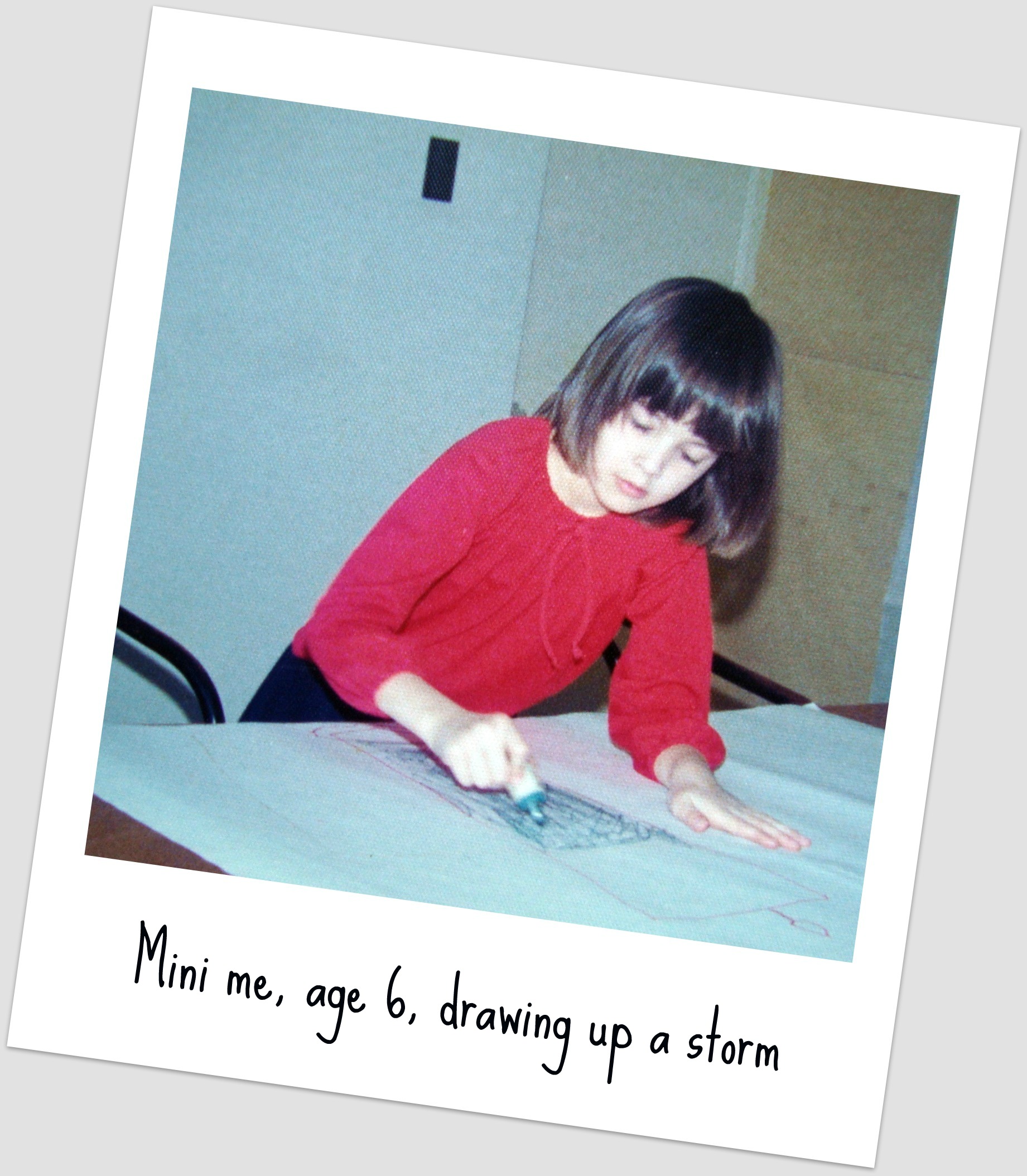
Now turning to the snapshot below: this is me, age 6, drawing a giant milkshake. I was playing at my dad’s office while he talked to important people on the phone.

Unlike the painting above, there was nothing subversive about my message, except, maybe, for the delivery. I remember those stubby markers made a deafening squeak every time I coloured in the solid areas. I coloured my arm off for the same reason I attached cardboard squares with clothespins to my bicycle spokes — so I could sound badass even if I couldn’t be badass (how could I? I had  handlebar streamers and a  basket on my bike).

p.s. If the painting is me, I think one of the guys in the Lodge saw it in an issue of Elle Canada several years ago. When an editor in chief doesn’t feel like writing a monthly message, they ask the other editors on staff to find a kid pic and we throw them on the page to delight and amuse the readers.

Update: if you want to find out what happened, here’s the whole story.

Comment on this post »

Fotoshop by Adobé

January 12, 2012

Thank you Jesse Rosten for this zeitgeist-y spoof of the beauty biz and self-esteem industry.

Being female never gets old.


Fotoshop by Adobé from Jesse Rosten on Vimeo.

Hat tip to DB Scott for posting this on his blog.

Comment on this post »

Resolution check-in

January 10, 2012

Comment on this post »

And now: James Franco, novelist

January 5, 2012

It has just been announced that James Franco has sold his first novel to e-tail giant Amazon. The reaction to the actor, his energy levels and the injustice of it all is entertaining on its own.


Comment on this post »

Smoking frieze

January 3, 2012


Photo: “Smoking Frieze” taken by my pal Keith Mulvihill, West 19th Street, NYC, January 3, 2012


Why should we use all of our creative power? Because there is nothing that makes people so generous, joyful, lively, bold and compassionate, so indifferent to fighting and the accumulations of [too many] objects and [too much] money.

Brenda Ueland

Comment on this post »

Looking back

December 28, 2011

I end 2011 …


Photo: Ryan Faubert/ Effects: Picnik.com


Comment on this post »

error: Content is protected !!