





Alison Garwood Jones

I Woman, you Man — what’s it all mean?

June 3, 2014

The #YesAllWomen hashtag has inspired a ton of stories by women describing what they experience on a daily basis just because they are women. For this, I go back to John Berger and an earlier post I wrote called, “Out of sight.”  Here is the podcast. Have a listen:


Left: Steve McQueen in The Thomas Crown Affair, 1968. Photo Credit: [ United Artists / The Kobal Collection ]. Right: Marilyn Monroe Reading, Long Island. Photo: Eve Arnold. Left: Steve McQueen in The Thomas Crown Affair, 1968. Photo Credit: United Artists / The Kobal Collection. Right: Marilyn Monroe Reading, Long Island. Photo Credit: Eve Arnold.

Comment on this post »

Language classes

May 30, 2014

At first we were told to study French.
And so we did,
Memorizing hundreds of verbs:
To resemble, to be like, to look like.
To loosen, to unleash, to let go.
To daze, to stun, to bewilder …
And when school was done with us, we found jobs in government.
Or moved to Montréal to become servers.
Most of us never bothered with it again, except …


Knowing even a little French was a source of smug satisfaction.
Especially in places like The Louvre Gift Shop:
“C’est un cadeau pour ma mère.”
Or the BNP line:
Pardonez-moi, je suis venu ici en premier.”
Or on boulevards at insistent businessmen:
“Va te faire foutre, Ass Hole.”
That told them.


Some of us added German and Italian to the mix.
But then we were told, “Nope, now it’s Chinese.”
现在 我需要知道中国
Tutors held us hostage for hours learning this language.
Our Twizzler consumption tripled.
We started to wonder whatever happened to Esperanto?
All those plans to foster world peace and international understanding?
This was right at the time we were saving the Whooping Crane.


Naturally, that moment passed and was replaced by another,
With brand new rules.
The Whooping Crane survived.
And from the head of Zeus sprung Code,
The new global language.
Our stress over the past perfect seemed so silly now.
So neoclassical.
HTML tables drowned out verb charts, periodic tables,
Powdered wigs and harpsichord scales.
Border collapses, vertical alignments, global attributes.
Amo, Amas, Amat.


Be bold.
That’s easy today: <strong>Take that</strong>
Colourful. Are you kidding me: <span style=“color: #ff0000;“>I’ve got plenty</span>
Ignore said punctuation at your peril.
Practice it for 14 hours a day — at least.
And don’t expect to get the girl.
Wait! Invent an algorithm to see if she’s single.
Come up with the best combinatorics, graph theory and string analysis.
Watch out for the Russians and Chinese.
Don’t sleep.
Don’t change your underwear.
Just win.
Then collapse with some beer, pizza and porn.


But wait …
If your idea of language is something other.
If bold to you is Angelou and Mandela,
And search is Odysseus, not Google,
Be prepared to justify yourself to the Arbiters of Now.
Steel yourself for a life of economic poverty.
Or learn to speak their language in exchange for food,
And come home at sunset
To shelves stuffed with gold and folded roadmaps to Byzantium.
Embrace compromise, but bookend each day with riches.
</span><span style=”line-height: 1.5em;”>Not the end.</span>

Comment on this post »

And still I rise

May 29, 2014

Thank you, Dr. Angelou. For everything.

Comment on this post »

Pilot Coffee Roasters

May 28, 2014

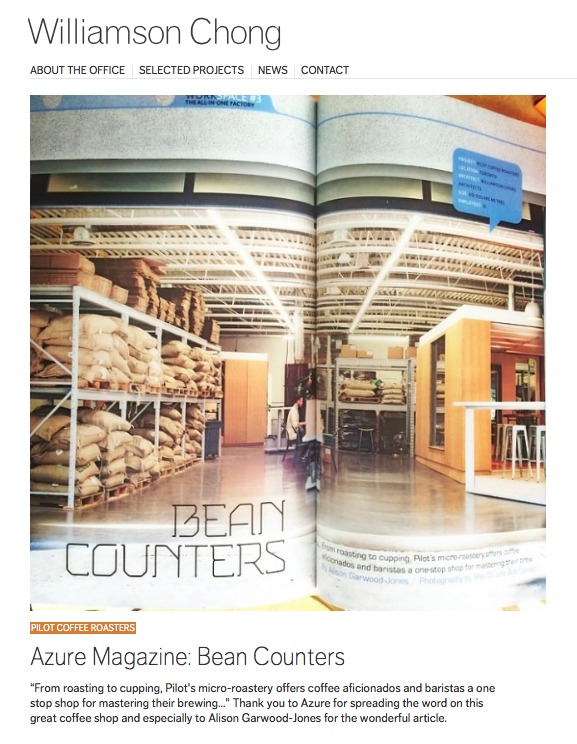
Pilot Coffee Roasters gets a makeover from Williamson Chong

Thanks for the ‪#‎Woot‬Williamson Chong.

In my humble opinion, architect Don Chong is the next Jane Jacobs.

None of that made it in to my profile of Don’s work for Pilot Coffee Roasters, but the evidence is sprinkled throughout the transcript of my interview with him. Some of you may remember Don for his “Small Fridges Make Good Cities” talk at IDS.

I haven’t posted the full article because I want to drive newsstand sales for Azure‘s June issue. That’s my retro act for the day, my shrug to Meta-data and SEO.

Comment on this post »

Tonight’s reading

May 22, 2014

My good pal, Jonathan Menon, sent me this: The New York Times Innovation Report, 2014. It outlines how the paper might reorganize itself into a truly “digital-first” organization. The report is 100 pages and will probably take me two baths to get through.

The Times admits its biggest weakness, still, has been its reluctance to shift the paper’s centre of gravity away from Page One. Their big gulp moment came when recent data showed that FlipBoard and The Huffington Post got more traffic from Times stories than the paper did.

The upheaval may be endless, but the message is clear: custom build your newsrooms for digital.

photo.PNG

 © The New York Times

Comment on this post »

Need LinkedIn help?

May 21, 2014

LinkedIn Manifesto

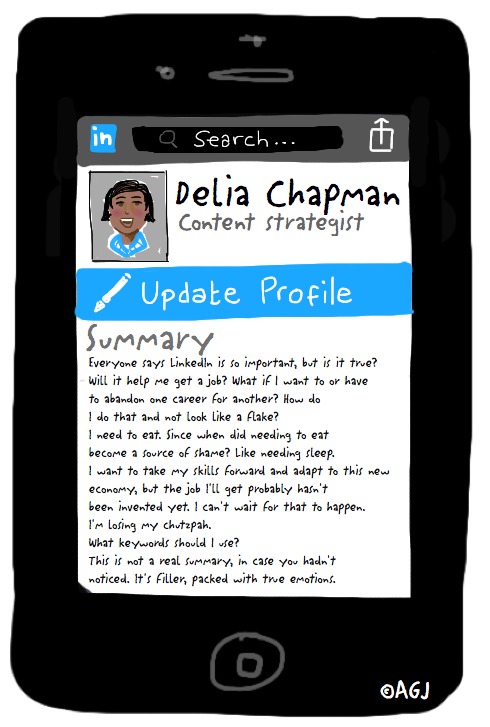
If you need LinkedIn therapy, I can help. I will:

• Interview you to reveal your unique story, then write your SUMMARY on the spot (with your approval, of course). Hint: this is not your old Word Doc résumé. Being entertaining matters.

• Show you where and when to insert KEYWORDS, then explain how the algorithm actually works in relation to recruiters and job suggestions. Hint: Don’t trip over keywords in your Summary. Save them for your SKILLS & ENDORSEMENTS section.

• Edit and improve your PROFILE PICTURE. We are hardwired to respond to faces, so don’t skip the pic.

• Help you craft your job EXPERIENCE so it shows your achievements, not your responsibilities. Hint: No shopping lists.

And much more …

I work by phone, Skype and Google Hangouts.

I also do house calls, coffeeshop tête-à-têtes and group LinkedIn sessions.

For more info, contact me at: alison.garwoodjones@gmail.com


Comment on this post »

CanCon in the digital age

May 12, 2014

Task Canadians with making a documentary and the world tunes in. Task us with creating a primetime TV show and the majority tune out. Threaten to take away our favourite American TV shows and it’s pitchforks.

Now groups like the Canadian Media Production Association (CMPA) are arguing that the Canadian Radio & Television Commission (CRTC) should move to regulate online video in the hopes of saving Canadian content (CanCon). Some of you may think our crappy selection on Netflix is precisely because that has already happened. Actually, the CRTC hasn’t touched Netflix.  Our poor selection is mostly the result of bandwidth restrictions. Still, our anger over feeling shortchanged shows just how entitled we feel as citizens of the internet to get the content we want regardless of borders.

All of this begs the question, in a digital age should the Canadian government be force-feeding us content stamped with its seal of approval? Beyond that, how do these content rules and restrictions mess with our creative spirit?

Well, to answer the last question, Canadian content rules have produced a lot of TV shows like these:

Canadian TelevisionClockwise: The Littlest Hobo, ©CTV; The René Simard Show, ©CBC; The Trouble With Tracy, ©CTV; Vintage TV set from dreams time.com Stock Images.

Compare that to what the three big U.S. networks were producing at the same time: All In The Family, Maude, The Mary Tyler Moore Show, M*A*S*H. I could go on.

CanCon Seal of ApprovalI couldn’t resist.

CanCon, ironically, is the biggest reason talented Canadians do their best work outside Canada. “Canadians  are operating within a system that doesn’t care about making hit shows,” said Jesse Brown in a recent podcast for Canadaland. (BTW, Brown’s show is funny, provocative and well researched. As good as it gets anywhere). But my favourite quote from the Canadaland episode, “Canadian Television is Doomed,” came when Brown asked,

“If tomorrow there was no regulated, government mandate in TV production [in Canada] would nobody start up their own web video company that could compete with everyone else, and could compete on quality as opposed to I’m the one who got the government commission? Wouldn’t it be good for artists and creators in the long run to have to sink or swim with everybody else?”

800px-Terrasses_de_la_ChaudiereCanCan Headquarters (the CRTC) in downtown Ottawa. Photo Credit: WikiMedia Commons

I’m guessing they already are, and we’ll hear about it soon. Furthermore, Brown is doing precisely that in audio. That independence is why he is asking the kind of pointed questions that CBC Radio would never touch.

Deregulating content would be a very scary move for Canadians of a certain age still working in TV and radio. I haven’t polled Millennials on their receptiveness to our content rules — if someone has, let me know — but I’m sure they’d say, “Go f*ck yourself,” and get back to creating, editing, hacking, beta testing and unleashing their projects on the world.

For the pro and con arguments on giving up our cultural policies, and what will happen when the CRTC moves to unbundle cable channels in favour of the “pick and pay” model, listen here to Brown in conversation with VMedia advisor, George Burger.

And let me know what you think, especially if you’re in the industry. Has CanCon helped or hindered your creativity?


Comment on this post »

The Wall

May 5, 2014

The paint pots are out in Toronto. Creative expression is thriving. I took these shots in the west end. The colours are for real.

DSC02015

DSC02012

Your brain and stuff

DSC02019

DSC02017

DSC02016

DSC02021

DSC02020

Chainsaw

DSC02013

Comment on this post »

Street smarts

April 29, 2014

A version of this post appeared in the April issue of Applied Arts Magazine.

Tokyo Shibuya Crossing“Electric City”: The author at the Shibuya Crossing, Tokyo, Spring 2014.

Partnerships with big-name brands are the bread and butter of most multinational ad agencies. They are what built Tokyo’s “Electric City,” New York’s Times Square and Toronto’s rapidly expanding Dundas Square — all hotspots of capitalism whose throbbing neon lights are visible all the way to the International Space Station. Zooming back to earth, to the Bloor Street office of Leo Burnett Toronto, all those persistent stereotypes we’ve come to associate with multinationals — the arrogant roosters, the slick slogans, the three-martini lunches — are nowhere in sight, despite the pileup of gleaming CLIOs and Gold Lions from Cannes (many of them still on the floor in boxes).

To be clear, the Toronto team — CEO and Chief Creative Officer Judy John, Creative Director Lisa Greenberg, Art Director Anthony Chelvanathan and Copywriter Steve Persico — continue to mastermind ad campaigns for big banks, furniture makers, restaurant chains and pharmaceutical giants, many of them so successful that the Toronto outpost has been named the company’s “Worldwide Agency of the Year” three times, besting every other Leo Burnett office around the globe (there are 96 in 84 countries). But ask John and her team what fuels their collective purpose as storytellers and they’ll tell you it’s their work for those shut out of the spoils of capitalism.

Judy JohnJudy John, Leo Burnett, Toronto

Back in 2010, when LB Toronto became a pro bono partner with Raising the Roof, a national organization committed to long-term solutions for Canada’s homeless, they began what has become an ongoing public education campaign to demystify the struggles facing street people. “There were no pitches or briefs,” says John, describing their first couple of meetings. The two sides just fell into a deep conversation that continues to this day and revolves around ways to get the public to stop and think about homelessness without judgment.

Lisa GreenbergLisa Greenberg, Leo Burnett, Toronto

For Raising the Roof’s first campaign, “Homeless Youth Have Nothing But Potential,” LB Toronto created a print ad and poster campaign showing a tufted armchair tossed to the curb with the quote: “You see an abandoned chair on the street and you think, ‘It has potential to be something beautiful.’ You see a homeless youth on the street and you think, ‘Don’t make eye contact.’”

The Street House, Toronto“The Street House,” Leo Burnett, Toronto

For the second campaign, LB Toronto chose a real-time interactive experience: erecting a five-room cardboard structure called “The Street House” in an alleyway in downtown Toronto. The house was open to the public during the annual Doors Open festival in May 2012. For an event focused on giving the public rare access to Toronto’s most architecturally significant buildings, the impact of touring a makeshift structure dedicated to the challenges of finding shelter was not lost on the 2,000-plus visitors who streamed through that weekend. Every misconception people may have harboured about the homeless — that they’re lazy, that they choose to be on the street — felt less true as visitors learned of the stories that drive some to the streets, and of the dangerous sleeping arrangements and struggle for food they face every day. To get the story, “we went to the shelters and churches and tried to interview every homeless person in Toronto,” says Greenberg. When asked to sum up how they saw themselves, words came easily to the homeless: “A graduate and a mother,” wrote one. “Caring and honest,” said another. “I am human,” said a third.

raising-the-roof-the-street-house-600-85573Leo Burnett, Toronto

Many visitors left The Street House feeling moved, challenged and bereft of immediate answers judging from the stream of tweets (#StreetHse) and Instagram photos they posted mid-tour, just two of the ways Burnett got the public to create buzz. The agency also placed print ads in Metro, The National Post, The Globe & Mail, tonight and Now Toronto, coupled with radio ads and online banners. And a week before opening, they posted a construction notice that acted as an OOH billboard promoting the project. A YouTube video with almost 4,600 views to date continues to increase awareness around the issue.

The Street House campaign won a Silver Lion at Cannes and a Design AACE, proving that the old saw about advertising and design being separate specialties is crumbling fast. “Design is such a big part of how people see things and consume information,” says John. “It makes sense for it to be part of what we do — although I think it’s taken the industry time to catch up to that.” Greenberg agrees. “For a while, [advertising] agencies could get penalized if they did good design. Some designers still get a bit rage-y because they feel we don’t have the right to be entering work.”

Leo Burnett Toronto’s ongoing partnership with Raising the Roof (dubbed their “passion account”) is in keeping with the agency’s overall commitment to working with clients guided by what they call HumanKind, or a ”big, compelling human purpose.” Arundel Gibson, Raising the Roof’s director of development, says that in the four years they’ve been partners, LB Toronto’s storytelling skills have made a difference, setting in motion systemic change that will impact governments, service providers and, most importantly, the 200,000 homeless in Canada. “[Judy and her team] work tirelessly to help us promote long-term solutions, and never make us feel like we are anything less than their most important client.”

Watch the video:

Comment on this post »

Winter’s last blast

April 3, 2014

I hope …

Winter's Last Blast

Comment on this post »

error: Content is protected !!