Alison Garwood Jones

Let humanity lead

July 9, 2013

richard renaldi

Richard Renaldi’s Touching Strangers project. Donate here.

Comment on this post »

One more time with feeling

July 3, 2013

True story.

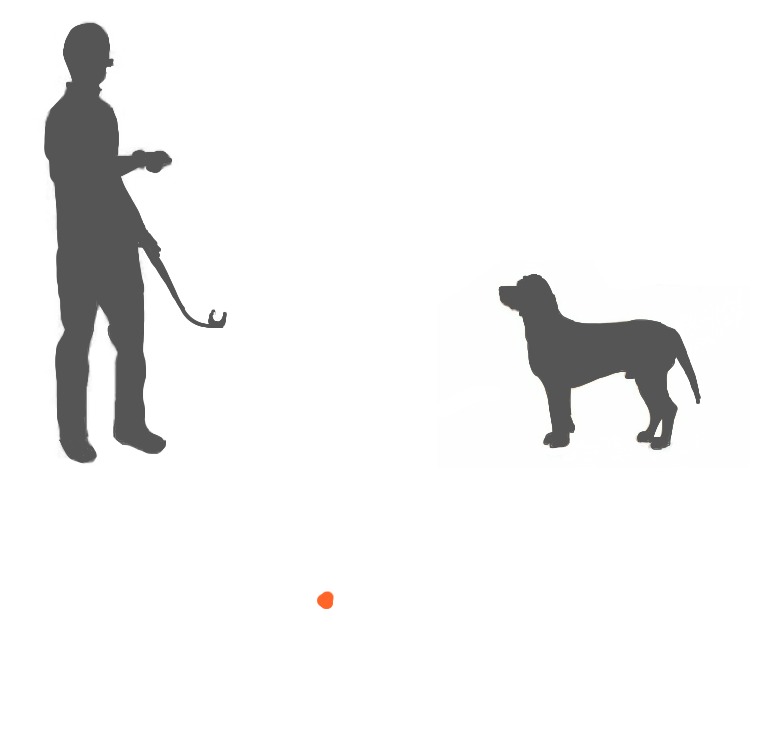
A man opens the gate to a dog park and Rover runs in, ears flying.

The man raises his Chuck It launcher and hurls an orange ball across the dirt pitch. Rover runs like a maniac to retrieve it and runs back just as fast, skidding to a halt at his master’s feet and causing a cloud of red dust to rise around them.

The man repeats this four times. By this point, Rover has rolled out the red carpet (his tongue) and is smiling from ear to ear while his tail is keeping time like a metronome.

On the fifth throw, the man’s smart phone sends him a text chime and he lowers the launcher to see who it is. Rover stands motionless panting and anticipating the next round of fetch. When the wait goes on too long for his liking, Rover barks to get the man’s attention. The man looks up, flings the ball, then resumes scrolling on his phone.

The ball lands with a thud across the park as Rover continues to stand motionless in front of his master. Not long after he drops his tail and switches it off.  The game is over as far as he’s concerned. Why? Because dogs don’t care about chasing balls. They care about engaging with us (children and spouses are remarkably similar and equally needy).

Our lack of engagement with life has been a running theme in my most recent blog posts. In my spare time I’ve been reading books to help me understand  the internet’s trajectory up until now and its effect on our central nervous system. I’m realizing that my mixed emotions regarding our technological progress aren’t that different to Marshall McLuhan’s. Back in the early 1960s McLuhan was continuously stating his contempt for the electronic age, and, yet, he also became technology’s biggest cheerleader.

I too like what technology can do for us, but loathe what it is doing to us. I’m not sure how to deal with that contradiction.

Man and Dog 2

 © AGJ 2013


Comment on this post »

Would you like to sit?

June 21, 2013

When a very fragile old woman has to walk to the back of a streetcar in search of a seat, something in society has changed.

Here are my theories:

1) We’re tired of banksters and governments misappropriating our investments and taxes. If we have a seat we’re not giving it up for anyone. Period.

2) We refuse to stand while our elected officials argue over the transit crisis.

3) No one taught us to protect society’s vulnerable.

4) Manners were a casualty of feminism.

5) We’re asleep.

6) We’re tweeting.

7) Rob Ford

Wendy Tancock Streetcar

Give up your seat. You’ll feel better, not worse. 

Amazing art by Wendy Tancock

Comment on this post »

Past perfect

June 11, 2013

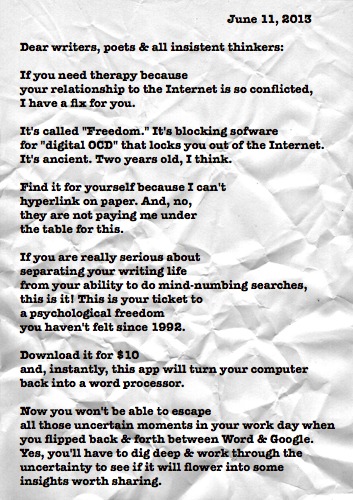
I’ve been carrying around this note in my pocket for you.

Digital OCD

Comment on this post »

Young & restless

June 3, 2013

iPhone Message cropped

Comment on this post »

Chicago

May 31, 2013

Chicago

In my mid-twenties, when I could have bottled my excess energy,  I was presented with a choice: Chicago or New York.

I weighed both options and chose Chicago. That runs counter to the narrative we’re used to for young women with vague dreams of writing. To arrive at that decision, I didn’t make a long list of pros and cons. I didn’t consult with anyone either. I used my gut and settled on the answer in seconds.

The Cézanne canvases in Chicago pulled me west first. But the city’s mythology kept me there (for a time). Chicago’s core sprung up like the pyramids after the Great Fire of 1871. Her speed, resilience and vision were breathtaking.

I like underdogs. I like ambitious city builders who fight like hell for good design. And I like big blue beyonds. Chicago has all three in spades. Also, less soot and cynicism settled on Chicago than New York. That better suited my temperament.

When I had an address there, I liked how the wind, constantly sweeping through the streets, lifted my imagination and kept it there. My dreams never hit the pavement in Chicago. They would have in New York. Frantic is not my style. Neither are sharp elbows or winning at all costs.

After living in Hyde Park (Obama’s old neighbourhood), I tried on the New York narrative when visiting Manhattan and tried it on again when I was back at my desk in Toronto and blogging about New York. Nope, it still didn’t get to me like Chicago.

I may have happily set up shop three Great Lakes over, but I still turn to Chicago — to the city sketches of Carl Sandberg, to the turbulent genius of Frank Lloyd Wright and the gravity-defying lengths of steel and glass at every turn — to pump my imagination and lift my words off the page.

Image: Art & Soul of America
This post is dedicated to my Chicago mentors: Suzanne Folds McCullagh and Douglas Druick.

Comment on this post »

Made in prison

May 16, 2013

YOU: Whaddya in for?

ME: I opted in. I pressed the button that said, “Create my account,” then I agreed to some terms I never read.

YOU: Ouch.

YOU: How long you in for?

ME: Life.

YOU: When did you do it?

ME: Five years ago.

YOU: Whaddya do with your time now that you’re stuck in here?

ME: Oh … ya know … I keep hitting the refresh button on my phone, laptop and tablet. I’ve learned to juggle all three in here. What else is there to do? I’ve been quarantined from my friends and family, I have no other distractions or responsibilities. This is it, man.

YOU: What have you accomplished?

ME: Is that a trick question?

YOU: No.

ME: It sounds like a trick question. I don’t appreciate that.

YOU: Now what are you doing?

ME: Dialing my lawyer.

YOU: Oh come off it. OK, let me rephrase that: have you made anything worthwhile? Written a book? Done some paintings? Some people become a gale force of productivity in here. Conrad Black wrote a 500-page memoir.

ME: Fuck off.

YOU: I’m just saying.

ME: I’m finding things to comment on and retweet. I’m pressing “like” a lot.

YOU: That sounds positive.

ME: Uh-huh. Actually it gets me nowhere. I hate being reactive all the time. It messes with my nervous system. I need to be pro-active to feel alive and engaged. I used to be the most disciplined and focused person I know.

YOU: Now look at you.

ME: (>人<)

YOU: What do you miss about the outside world?

ME: I miss the sound of lawn mowers and the smell of fresh cut grass. I miss dangling my legs off the dock, feeling the sun burn into my skin, telling time by the sky. I miss navigating the silences in conversations with nothing but my wits and raw emotions. I miss the smell of books and sitting on the porch swing.

YOU: So write about that then.

ME: Yeah … Yeah, you’re right. But do you think people would understand it?

YOU: Hard to say.

ME: I think I need to try.

Comment on this post »

Remains of the day

May 12, 2013

I got a lot of moving feedback the first time I wrote about my mother, Catherine, in The Long Goodbye, published three years ago on this blog. After she died last Christmas, I expanded on the story of our relationship and turned it into a magazine piece for Glow Magazine. It’s in the May issue, on newsstands for just a few more days. Happy Mother’s Day. I dedicate this to Peter and Richard.

M y mother knew her entire adult life what was coming. Confirmation arrived the day she shuffled into the kitchen, swung open a cupboard door, then turned to me and asked, “Where are the singing noodles?” On that day, I stopped leaning on Mum and started extending a protective hand. Before long, pots began appearing in the oven and car keys in the fridge, while Post-it Notes with basic English words multiplied across every surface of the house—all quirks of the onset of Alzheimer’s, the disease that took her mother 30 years earlier.

Nothing deletes one’s individuality so completely as Alzheimer’s. Its imprint is the same in everyone who gets the diagnosis; they all disappear down the same path, exhibiting more or less the same set of behaviours. Most go from unique citizens of the world to nervous fusspots crying “No! No! No!” (the last word in their drained vocabulary), and then to silent bodies with gaping mouths and fixed stares. That’s why I prefer to think about what made my mother unforgettable, before age flicked a switch and unleashed this great leveller.

For someone born before the Crash of ’29, my mother had a remarkably liberal view of a woman’s place in the world. She honoured the individuality of every soul she met, so unconventional choices—like making art full-time, or not having kids—never sent her into a tailspin, unlike some women in the neighbourhood. In her day, women attached themselves to men like the stateless to lifeboats, their fortunes rising and sinking with their rescuers. All too often, you married the man you wanted to be: aspiring novelists teamed up with writers (becoming their typists, first readers, editors, even ghostwriters), while nurses said “I do” to doctors and vowed to always pass the scalpel but never perform with it. Mum believed in developing a person’s potential, not denying it.

CathGJ 1951Catherine, new bride, Summer of 1951.

When I grew up and decided that filling a blank page with words constituted a large chunk of my identity, she was right beside me. During that formative period, she didn’t interrupt my progress to tutor me about men. I now see that was deliberate. Back then, I had no interest in integrating my personal and creative lives. What were guys to books? When we did talk men, she just smiled, looked me straight in the eye and said, “You’ll have to figure that one out on your own.” Confounding, but true.

All the while, she kept feeding my individuality. Every time I came home at Christmas, there was a new book on the end of my bed, touching on one of my interests: painting, history, biography. Those volumes have moved with me to every place I’ve lived in since university: There’s the doorstopper, Paintings in the Musée d’Orsay, the elegant Chinese Brush Painting Techniques and Anne Morrow Lindbergh’s Gift from the Sea, an ode to the forces that shape a woman’s life. Mum owned about five editions of Lindbergh’s book, some with line drawings of shells, others with thick, creamy, deckle-edged pages. When it was revealed several years ago that the author’s husband, Charles, had fathered two families—his famous one with Anne and a secret one with a German hat maker more than 20 years his junior—Mum was too sick to know. But I think I can guess what she would have said, or not said. She wouldn’t have rolled her eyes like a know-it-all or uttered something cynical about men. I’m positive she detected it in Anne’s lucid and compelling writing. Like Anne, pain only increased my mother’s grace.

[pullquote]I said she reminded me of a young Princess Elizabeth: efficient and sensible most of the time, but stunning when you least expected it.[/pullquote]

I don’t know if, as a young woman, Mum fretted about her marital destiny. I never asked. Clever and capable, she could have supported herself teaching piano or assisting a company president. And yet she had a charm and grace that deserved an outlet and some focused attention. When she spread red Max Factor on her lips, she dazzled enough to startle her future mother-in-law to the point of distrust. And more than once, during her younger days in London, England, she tripped up the men she passed on the way to her secretarial job near the city’s Marble Arch. Teasing wasn’t her style, but I’m sure times like that, when she distanced herself from the starched-wimple set, pleased her. I said she reminded me of a young Princess Elizabeth: efficient and sensible most of the time, but stunning when you least expected it. It was hard not to do a double take of my mother when she stained her lips and stood with a drink under a sparkling chandelier, smiling and talking about the things she cared about. Her natural vivacity pulled everyone toward her.

No one knows what Alzheimer’s looks like from the inside out, but Mum gave us a hint. She was acutely aware of everything she was losing and the declarations just poured out in the end. “I want you to be happy,” she said, still not serving up a prescription for how I should get there. “I love that guy,” she stated, smiling and pointing to my dad, sitting next to her in his La-Z-Boy watching the Golf Channel. She must have said “I love you” to him more times in her last year of speech than in the final two decades of their 60-plus years of marriage. Most times, he was too busy staring at the TV—wincing at a missed putt—to hear. But he knew, and we knew, because she was telling the whole world. I’m glad I witnessed this as an adult. The romantic in me wants to believe in love’s power to cut through chaos, disappointment and change.

A few months before we handed Mum over to the care of a team of nurses, she called and left a message on my answering machine. Something in me said, This will be the last time she picks up the phone and dials my number. My hunch proved true. I played her message over and over that week, then popped a blank tape in my boom box and pushed “record,” so I’d have her voice with me forever.

It’s been 12 years since she left that message and I haven’t listened to it since. I can’t. At that moment in time, she put aside her doubt and fear for herself, and with a shaky, lilting voice she said: “I miss you, Alison. I just wanted to let you know I think about you every day and hope that everything’s going well in Toronto. I love you.” From the commotion, I could tell she missed placing the receiver in the carriage on the first try. That vulnerability makes my knees buckle every time I think about it.

Catherine Garwood-Jones died on Dec. 9, 2012, one year after her husband, Trevor.

Mommy & AlisonCatherine and Alison hugging (a common pose for us).  1993.

Drop cap by Jessica Hische

Comment on this post »

Future shock

May 1, 2013

Shitty things can happen when good people do nothing. This is my interview with Story Board, the blog for the Canadian Media Guild and the Canadian Writers Group. The internet spreads stories, voices and awareness, when we use it well.

Story Board Banner

The 5-Minute Freelancer Q&A #8 – Alison Garwood-Jones

In this regular feature, Story Board asks Canadian writers to share a few details about their work habits and their strategies for navigating the ups and downs of freelance life.

1. What’s your strategy for generating story ideas?

A lot of it is just looking at the landscape and seeing what inspires me, what enrages me and seeing if I can respond to it in an engaging way. It comes from everything. I flit around from the computer to magazines, from print to digital, just trying to stay aware and trying to stay engaged myself and then seeing if I can spin it through my own sensibility on my blog. It’s everywhere. It’s based on what I see when I go to the AGO, it’s based on what I experience when I’m hanging out with friends at a restaurant, what are they talking about? What’s the latest app they’re using? My blog covers a wide range of topics, I put it under the umbrella of human nature, but I think what’s happening in the digital world is a good example of how human nature responds to new toys and new forms of communication.

And I’ve had several blog posts turn into pieces because editors have gotten in touch with me saying “that was really moving or really interesting, do you want to expand on that into a print piece?” I’ve always found that if something really gets me going, I’m probably not the only one.

2. What’s the most important thing you’ve done over the years to develop your writing skills?

Probably start blogging. I was reluctant in the beginning. I got into journalism late in my career. I had a whole other life as an art historian. And then I decided I wanted to be less of an academic and get into journalism and write for a broader audience. Write for the common reader, as Virginia Woolf said. I just wanted to engage on a more sort of visceral level with people through writing. The nice thing about getting into journalism in 2005 is that I was right on the tail end of the golden age of journalism. So adapting to a new environment in social media and web 2.0 wasn’t as hard for me. I wasn’t as invested in the old way. I hadn’t been in it long enough. A quote I put up above my desk was “I’d better flee into the future as fast as I can.” So the smartest thing I did was build a website, start blogging. I wouldn’t say getting on Facebook was necessarily a smart thing! But Facebook and all the social media platforms like Twitter and Pinterest are great for alerting people when you’ve got a new blog post and that’s how you drive traffic, obviously, back to your homepage.

I’m finding now that blogging… whereas before I was a little wary, like “what’s this all about, it’s devaluing the work of print journalists,” now I feel more like, wow, this is the biggest revolution for writers in I don’t know how long. And I’m really in agreement with Craig Silverman when he wrote last year on Facebook in a comment, he said “I see my blog emerging as the primary focus of my work, with the print column representing a unique extension and opportunity.” And when I read that I instinctively knew that’s exactly how I’m feeling as well. I honestly feel like my blog and my website is a sandbox for me. It’s where I workshop ideas and really work on my craft.

3. Do you think there’s ever a situation when it makes sense for a writer to write for free, and if so, when?

For me it makes sense on my blog, obviously. The fact that I haven’t entertained any advertisers is important. That’s deliberate. I want complete freedom. With my own work, I don’t have an attitude that every word I write is worth so much. Now outside of that it is a little more complicated. I definitely don’t think writers should undersell themselves. I think we’re at a watershed period where what’s happening right now with contracts – the all-rights grabs – is definitely an opportunity for writers to step back and say “no, this is unacceptable.” And it’s a scary step to take and a lot of people have shown an enormous amount of courage, Amber Nasrulla and Jay Teitel, and they speak for so many of us and they have my full moral support. This is a time where you almost have to live your life as a writer assuming that all publishers will go this route and will try and grab all moral and digital rights. So it means that we have to be really smart about looking for ways to pay our bills that don’t necessarily involve writing for magazines. Hopefully we can continue to do that and not all publishers will go with these kinds of contracts.

But I think you have to, as a businessperson, be really smart and say “okay because I refuse to sign that, let’s figure out how I can create a patchwork income doing a whole bunch of other different things so I can continue to write.” It may mean only continuing to write on your blog, who knows. But right now we’re going through such a transition period with so many interesting possibilities. Derek Finkle’s brought this up: self-publishing is becoming a really interesting and, as he said, a subversive tool for writers. A writer can take a larger cut of the royalties through self-publishing than they can through the traditional route. And that’s never happened before. There’s never been that much opportunity for writers to have control over their content and their royalties. So it’s a big transitional period, I find it really exciting.

Would I write service journalism for free? No, because I’ve already been on staff and you get to a point in your career where you know you have a certain skill level and it would be so regressive. Like the old saying goes “you can’t eat exposure.” At some point you don’t need more exposure. That’s not your goal. It’s about a business relationship and a respectful one on both sides. It’s tough. And I think it’s something they need to teach. They need to have these hard business-type discussions with students. It’s not all about crafting stories and narrative arcs. It needs to be, okay, you have to think about how long you’ll accept writing for free and at some point know that you can up the ante and start negotiating. And it needs to be earlier than I think what people have been doing. It’s amazing what you can get if you just ask for it. And not enough writers are doing that.

4. Work can take over your life when you’re a freelancer. What do you do to try and maintain a healthy work-life balance?

I walk a lot. I go out in the sunshine. I have a part time job at a bar downtown and that takes me outside of my head, helps me pay my bills and is a complete change of pace for me from the solitary life of writing. I think it’s important to mix up the kind of work and play that you do so that it’s not all surrounding writing or talking about writing. I just try and do things that are the polar opposite of what I might do at my desk. And that’s a good mental break.

• Alison Garwood-Jones is a Toronto-based writer and blogger. Her writing appears in the current issues of Glow, Azure, and House and Home and her blog, Society Pages was nominated for a 2013 Canadian Weblog Award. You can follow her on Twitter at @AlisonGJ.

Comment on this post »

Show up

April 26, 2013

What was true then is true now: focus and discipline will take you far.

I showed up at the kitchen table almost every day of my young school life. It was “homework central” in our house (well, I made it so).  And sometimes it was a group effort.

My mother had a day job, but she was never too tired to sit down with me and demonstrate how to craft a better sentence or solve an equation. Boy, was she patient with my math skills.

So when a day that starts out feeling uncertain finishes with a sense of accomplishment, it’s because you showed up. Working gives you more energy, not less.

Homework


Comment on this post »

error: Content is protected !!