In a display of human nature at its worst, I once worked with a fashionista who sneered, “Old ladies smell like sour milk.” Wow, I thought, if women can be this disdainful of their mother’s generation, we’ve got a problem. Judging by popular culture, society as a whole finds post-fertile women not worth looking at or listening to.
I wrote about this in a post called Best before dates back on March 4th. I said, one way we could encourage a cultural shift in our uncompassionate take on women and aging would be if filmmakers started telling more cradle-to-grave stories of women’s lives on the big and small screen. Pounding away on my keyboard I went on to say, it’s time to break the pattern of ending women’s stories a quarter of the way through with a fairy tale wedding, a climactic shopping spree, a premature cancer diagnosis or a car chase off a cliff (à la Thelma & Louise).
Seeing women on screen in all their various stages of life — and not just the first blush of youth before anything interesting or noteworthy has happened — is an affirmation of our entire time on this earth. Call it kitchen wisdom, but if we want to live, we have to age. So let’s stop averting our gaze before it’s over. Let’s follow the narrative arc of a woman’s life right to the end, highlighting her accomplishments, sharing the lessons she’s learned and spilling a few tears over the moments when the meaning of it all burned the brightest.

When I wrote these words three months ago, I hadn’t met Maureen Judge. Judge is an award-winning Toronto filmmaker who is filling that storytelling gap I lamented with rich and complicated profiles of Canadian women, ranging in age from 18 to 101. Her one-hour docs hold up a mirror to situations we’ve all experienced (or will experience), but have a hard time acknowledging: the changing nature of love over time, where we go when we age, and what happens to us when life doesn’t unfold the way we thought it would or should.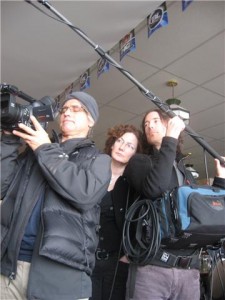
Her latest film, Mom’s Home, premiering May 5 at 10:00 pm on TVO, focuses on the autumn of three mother/daughter relationships and how aging, and in one case an Alzheimer’s diagnosis, has changed the dynamic in each. All three stories show the commitment most women feel “to do what’s best” for their families, and often without the support or input from men.
[pullquote]Mom’s Home premieres May 5 at 10:00 pm on TVO.[/pullquote]
I sat down with Judge last week to talk about Mom’s Home. But before I launch into our Q&A, I want to introduce you to the three mother/daughter duos she captures so beautifully on film. Economic and health concerns have forced the women to move in together.
May and Gloria
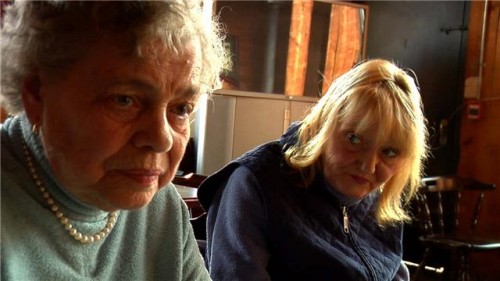
May moved in with her daughter, Gloria, three years ago just after her husband died. Gloria is also a widow. Originally from Scotland, this mum and daughter duo live together in a cramped walk-up in small town Ontario. May is 82, still puts on bright red lipstick every day and keeps the ashes of her husband and a pet budgie in decorative boxes on the dresser of her cluttered bedroom. Gloria wrestles with having to leave her mother every day to go to her job as a cook at the local diner. May has Alzheimer’s and as her condition worsens, Gloria realizes something’s got to give. She needs help.
Harrian and Charmaine
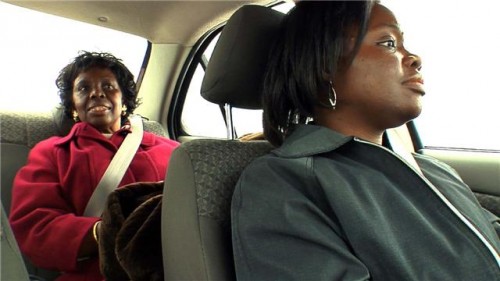
Harrian moved in to her daughter Charmaine’s suburban home after years of living with her son, Carl, and his family. Both women are divorced. Despite getting the heave-ho from Carl —“Moms should stay with their daughters,” says Carl, adding that his mom was starting to “annoy” him — Harrian is wonderfully good natured about the prospect of moving into Charmaine’s place and taking over the cooking, cleaning and entertaining. Charmaine, who has always wanted her mother’s approval, is only too pleased to have her. “I don’t’ know how long I’m going to be here,” says Harrian. “We’ll see.” Charmaine works with a real estate firm, staging houses for sale. Harrian often accompanies her on jobs, although, at times, her daughter finds her more of a burden than a help. That upsets Harrian.
Pam and Liz
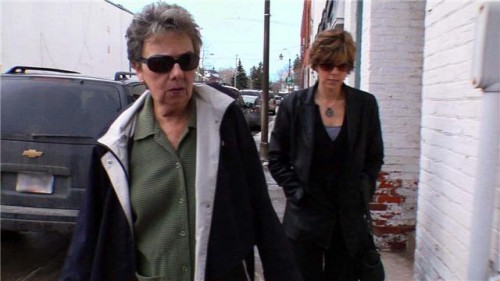
Pam and Liz are the most conflicted about their living situation. Both are divorced and have been roommates in Liz’s home, along with Liz’s two young sons, for the past eleven years. Worried about money and her mother’s well-being, Pam feels bitter and stuck that she can’t get back her own life. Pam also wants a final period of independence before her she gets too old to take care of herself.
Q&A
AGJ: Has Alzheimer’s touched you personally?
MJ: My great aunt Rebecca had it. She lived most of her life in Windsor. She was a batik artist and made quite a mark through her work. She married late in life because she was looking after her mother. But it wasn’t long after she married that her husband got sick and died. She was always forgetful, but this was long before she had Alzheimer’s. At one point, my brother, who was living in Windsor at the time, noticed there was nothing but cigarettes in her fridge. That’s when my parents invited her to move to Toronto so they could keep an eye on her. She moved down the street from them. By that point, I was already living on my own, but I still saw her. Aunt Rebecca would take long walks. Every day she would go to the TD Bank at Sherbourne and Bloor [in Toronto]. They all knew her there. I would run into her a few times at The Bay and she’d say, “Dearie, Dearie, can you tell me how to get home?” She was totally lost. There were times too when she’d wander up to my parents house in the middle of winter with no coat on. She almost lived like a bag lady, but she wasn’t. My family was there for her. Aunt Rebecca lived down the street for quite a while until her behavior became too erratic. The final straw was when she jumped from her first floor window in the middle of the night with no clothes on. At that point, my parents put her into a nursing home.
Why is it important for you to tell these kinds of stories?
They go right to the heart of family realities. Family has always been my centre. It’s how I relate to the world. I’m one of eight kids. We moved around quite a bit when I was young, so when people asked, Where are you from? I’d say, Well, I dunno, I’m from my family. I was born in Montréal, then lived in Kingston, then Chicago and I finally ended up here in Toronto. I think there is a lot of drama in families. It’s a microcosm of society as a whole. For me, that’s where I find my nourishment for stories and for love and for all the ugly stuff too. It all gets mashed up together.
What do you like best about working with older women?
They’re funny. They say what they think and don’t care about the consequences anymore. I love their sense of freedom.
Do you think that women who are widowed, divorced, or temporarily “over men” tend to team up more to form support networks than men do (divorced men just look for a new woman to look after them).
That’s really interesting. I don’t know. I don’t have any stats. But I would think that’s true because, for women, family is still their base, so they’re able to reach out more. Even in a car, if someone gets lost who’s the one who asks for directions? It’s the woman because we don’t have that sense of having to be independent and alone and making it in the world without anyone else’s help. Also, women live longer than men. There are a lot of single mothers, divorced women and widows out there.
How did you find your subjects?
I found community newspapers were the best way to get at people. Those papers hang around for a week. People flip through them and tear out pages. I was also a guest on CHUM FM with Roger, Rick and Marilyn and got a ton of responses after I described what I was doing. I did CBC radio in the afternoon with Matt Galloway. I also got in touch with the YWCA, and did a couple of seniors speaking engagements.
Did the three pairs of mums and daughters you finally chose let you know why they wanted to get involved?
No. And I never ask, but I usually know.
Why did May and Gloria decide to participate?
That’s an easy one. Gloria wanted some entertainment for her mother. May was so excited to have the camera there because she had always wanted to be a movie star. I thought they’d be the love pair. Actually, I think Charmaine and Harrion are the love pair because there’s less pain in their lives. With May and Gloria, they had to move in together, but they also loved being together. They’re joined at the hip.
Pam and Liz came next. They were much more reserved, more WASP. I chose them because they really didn’t want to be together. They were both in this rut and didn’t know how to get out of it. Both had other dreams, and they weren’t shared dreams. But here they were sharing this house together with the kids and the dog. They were tied together and it wasn’t so much about love, it was economics. I thought a lot of people would understand them.
I think Liz represents the resentment that a lot of adult daughters feel. Her life is on hold. She can’t decide if she should marry her boyfriend, but she doesn’t want to pull him into her current situation. She’s stuck.
But Pam is stuck too. She’d like to go out on her own before she’s too old. She’s wondering, What’s going to happen to me?
What about Charmaine and Harrian?
I chose them because they were so much fun. By then, I’d been around Gloria and May and realized there was a pretty dark side to their circumstances. Charmaine and Harrian’s situation wasn’t all that dark. Yeah, ok, her son pushed her out. Carl wasn’t very nice, but Harrian had so much spunk. I also liked the fact that Charmaine basically wanted her mother to like her. She wanted to be the favourite child. That’s why she wanted her mother to live with her. This was her way — and I don’t mean this negatively — of insinuating herself more deeply into her mother’s life. Being one of eight kids I really understood that. You want to figure in your mother’s life. Charmaine’s goodness was allowed to express itself as a result.
Did any of the women have troubles letting you into their lives with a camera?
No. I don’t start shooting until I have some sort of relationship with my subjects. I got to know them over coffee, over phone calls. I wanted them to like me too. I have to let them into my life as a filmmaker. I know that if I miss anything in my initial interviews, when I don’t have cameras and mics around, I’ll get it again. People’s lives are very repetitive.
In the story of May and Gloria the word “Alzheimer’s” wasn’t spoken until about 9 minutes into the film. And it only came up once.
Right.
The women weren’t saying it. Why was that?
Because they live it. May was repeating herself all the time. You know, it’s there but it’s not spoken. She’s also in the really early stages. I didn’t want the medical condition to take over the whole film. And it doesn’t. This is not a film about Alzheimer’s; it’s about relationships and how they are changed by Alzheimer’s and all the other concerns related to aging.
I like what Charmaine said, “I’m learning to live with a completely different woman [than the one I grew up with].” It’s about meeting your mother at another stage of her life and getting to know her all over again.
Yeah, it really is.
Do you think people dance around Alzheimer’s the way they used to dance around cancer? You know, “She’s got the “C” word” (said in a whisper).
I think people do. I think they’re afraid of it. They’re afraid of getting it themselves. I think losing your mind is scarier than anything else. I have a brother who’s schizophrenic. It’s the same idea of losing your mind and not being able to control where it goes.
Do you think this teaming up of the generations will be a social trend over the next 30 years as Baby Boomers age?
I do. I think it’s an economic necessity mostly. All three pairs in the film had financial problems. They weren’t able to have their own homes. I think it’s a cultural thing too. As more people from other countries immigrate to Canada it will be more acceptable for multiple generations to live under the same roof. This will just become assimilated into our culture. I think it’s a good thing. When push comes to shove, you may not have chosen your family, but you are born into it and that’s who’s going to be there for you in the end. I also think mothers and daughters are inextricably bound together. That is the most satisfying part of making this film. I got to know some really great people who taught me a whole lot of life lessons.













 A year ago, if you’d asked me about blogs I would have told you I resented them.
 Was it when
















 I imagined rooms dressed in faded cream and mint striped wallpaper that was peeling back at the edges and marked up by run-ins with Louis XV furniture.