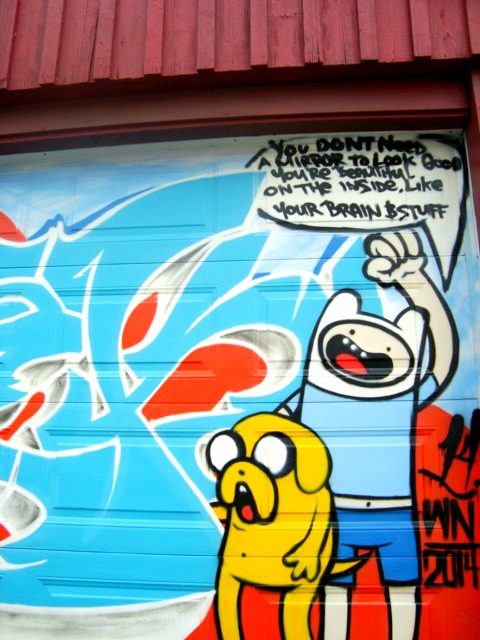
The paint pots are out in Toronto. Creative expression is thriving. I took these shots in the west end. The colours are for real.

















May 5, 2014
The paint pots are out in Toronto. Creative expression is thriving. I took these shots in the west end. The colours are for real.
April 29, 2014
A version of this post appeared in the April issue of Applied Arts Magazine.
 “Electric City”: The author at the Shibuya Crossing, Tokyo, Spring 2014.
Partnerships with big-name brands are the bread and butter of most multinational ad agencies. They are what built Tokyo’s “Electric City,” New York’s Times Square and Toronto’s rapidly expanding Dundas Square — all hotspots of capitalism whose throbbing neon lights are visible all the way to the International Space Station. Zooming back to earth, to the Bloor Street office of Leo Burnett Toronto, all those persistent stereotypes we’ve come to associate with multinationals — the arrogant roosters, the slick slogans, the three-martini lunches — are nowhere in sight, despite the pileup of gleaming CLIOs and Gold Lions from Cannes (many of them still on the floor in boxes).
To be clear, the Toronto team — CEO and Chief Creative Officer Judy John, Creative Director Lisa Greenberg, Art Director Anthony Chelvanathan and Copywriter Steve Persico — continue to mastermind ad campaigns for big banks, furniture makers, restaurant chains and pharmaceutical giants, many of them so successful that the Toronto outpost has been named the company’s “Worldwide Agency of the Year” three times, besting every other Leo Burnett office around the globe (there are 96 in 84 countries). But ask John and her team what fuels their collective purpose as storytellers and they’ll tell you it’s their work for those shut out of the spoils of capitalism.
 Judy John, Leo Burnett, Toronto
Back in 2010, when LB Toronto became a pro bono partner with Raising the Roof, a national organization committed to long-term solutions for Canada’s homeless, they began what has become an ongoing public education campaign to demystify the struggles facing street people. “There were no pitches or briefs,” says John, describing their first couple of meetings. The two sides just fell into a deep conversation that continues to this day and revolves around ways to get the public to stop and think about homelessness without judgment.
 Lisa Greenberg, Leo Burnett, Toronto
For Raising the Roof’s first campaign, “Homeless Youth Have Nothing But Potential,” LB Toronto created a print ad and poster campaign showing a tufted armchair tossed to the curb with the quote: “You see an abandoned chair on the street and you think, ‘It has potential to be something beautiful.’ You see a homeless youth on the street and you think, ‘Don’t make eye contact.’”
 “The Street House,” Leo Burnett, Toronto
For the second campaign, LB Toronto chose a real-time interactive experience: erecting a five-room cardboard structure called “The Street House” in an alleyway in downtown Toronto. The house was open to the public during the annual Doors Open festival in May 2012. For an event focused on giving the public rare access to Toronto’s most architecturally significant buildings, the impact of touring a makeshift structure dedicated to the challenges of finding shelter was not lost on the 2,000-plus visitors who streamed through that weekend. Every misconception people may have harboured about the homeless — that they’re lazy, that they choose to be on the street — felt less true as visitors learned of the stories that drive some to the streets, and of the dangerous sleeping arrangements and struggle for food they face every day. To get the story, “we went to the shelters and churches and tried to interview every homeless person in Toronto,” says Greenberg. When asked to sum up how they saw themselves, words came easily to the homeless: “A graduate and a mother,” wrote one. “Caring and honest,” said another. “I am human,” said a third.
 Leo Burnett, Toronto
Many visitors left The Street House feeling moved, challenged and bereft of immediate answers judging from the stream of tweets (#StreetHse) and Instagram photos they posted mid-tour, just two of the ways Burnett got the public to create buzz. The agency also placed print ads in Metro, The National Post, The Globe & Mail, tonight and Now Toronto, coupled with radio ads and online banners. And a week before opening, they posted a construction notice that acted as an OOH billboard promoting the project. A YouTube video with almost 4,600 views to date continues to increase awareness around the issue.
The Street House campaign won a Silver Lion at Cannes and a Design AACE, proving that the old saw about advertising and design being separate specialties is crumbling fast. “Design is such a big part of how people see things and consume information,” says John. “It makes sense for it to be part of what we do — although I think it’s taken the industry time to catch up to that.” Greenberg agrees. “For a while, [advertising] agencies could get penalized if they did good design. Some designers still get a bit rage-y because they feel we don’t have the right to be entering work.”
Leo Burnett Toronto’s ongoing partnership with Raising the Roof (dubbed their “passion account”) is in keeping with the agency’s overall commitment to working with clients guided by what they call HumanKind, or a ”big, compelling human purpose.” Arundel Gibson, Raising the Roof’s director of development, says that in the four years they’ve been partners, LB Toronto’s storytelling skills have made a difference, setting in motion systemic change that will impact governments, service providers and, most importantly, the 200,000 homeless in Canada. “[Judy and her team] work tirelessly to help us promote long-term solutions, and never make us feel like we are anything less than their most important client.”
Watch the video:
April 1, 2014
Republished on J-Source, The Canadian Journalism Project.
Every era has its hiring challenges. In the Dirty Thirties, when there was no work, men spent more time in soup lines than job lines. “You couldn’t even buy a job,” so went the popular catch phrase of the era.
By the 1950s, there was plenty of work, although the best jobs were reserved for men. Here’s a typical scenario from that time:
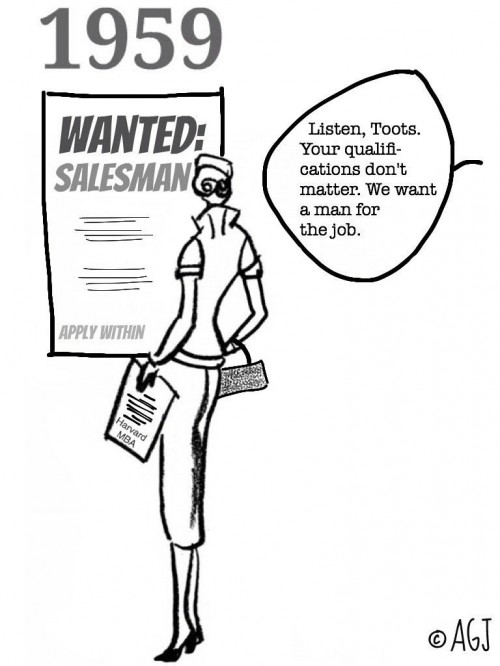
“Toots” (her name was actually Margaret), only managed to get a job as a receptionist at this company, although she was qualified for sales. Once she was in the door (that’s all she needed), she slowly revealed her smarts to a sympathetic male colleague while keeping her Harvard M.B.A. a secret from the rest. After a decade, Margaret (still “Toots” to the guy in HR) was finally moved into sales. Throughout the 1960s, the men she trained were repeatedly promoted ahead of her while she caught and discreetly corrected their missteps. By the late seventies, with her sexual appeal no longer a distraction and her seniority beyond dispute, Margaret was promoted to Chief Sales Officer.
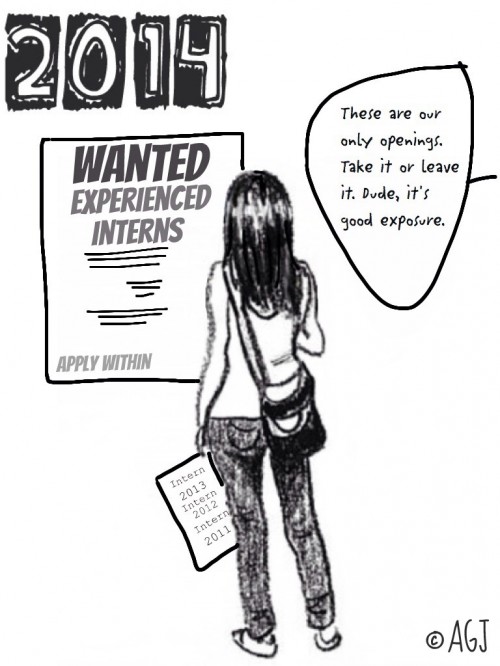
Now it’s 2014 and a different mix of circumstances has resulted in a hiring pattern that’s affecting young women and men alike. It centres around the options available once you’ve completed your first internship, then your second, your third and, maybe, you’re even considering a fourth because the exposure of the first three hasn’t yielded fruit … yet.
Getting a job has always required hustle, grit and persistence. Guarantees? Are you kidding me? There are none. But in the last two decades, more businesses have been turning up the dial on unpaid labour. For most of us — and I include myself in this — we were either too busy and ambitious to notice what was happening (after all, we got great internships) or too polite, paranoid or privileged to point out how the practice was starting to get out of control.
Through all four of my internships (1990, 1992, 1993 and 2004), I was acutely aware of being on the right side of luck. Sure, I wrote my way in every time with a compelling cover letter, then secured scholarship money from my university when the internships didn’t or couldn’t offer a stipend (however, three of my four internships did pay me almost minimum wage). I also had a restaurant job and my parents to fall back on when times got tough. Coincidentally, so did every other intern around me when I was at The Smithsonian Institute in Washington, D.C. and the Art Institute of Chicago (not the restaurant job, the parents). Not so at the Musée D’Orsay, where I worked with French and Dutch research interns and fellows who were fully subsidized by their governments. These students didn’t have the shiny hair, expensive watches and delicate jewelry we all had in Chicago, Washington and Toronto. They seemed not to have two sous to rub together and lived on coffee, cigarettes and paperback classics. But that was cultural, not from a lack of assistance.
Before I segue to the present, I want to do a shout out to my parents, Catherine and Trevor. They were so pro-arts, it was laughable. I’m still smiling at their warped priorities, and taking great pleasure in the beautiful books on art and culture they presented me over the years, and which now line my apartment. About twice a week, I interrupt my writing and drawing efforts to throw my thanks to the sky, “You guys rock!”
• • •
I kept tabs on the interns I worked with over the years and all of us hustled once again to find entry-level positions in galleries, film production companies, magazines and academia. In the nineties, entry-level jobs had not been wiped out by unpaid internships. And this is what differentiates the circumstances facing young people today. Unpaid internships turned into a more widespread practice when the Great Recession and social media hit simultaneously in late 2008. That’s when “free is the new business model” became the catchphrase of this era and magazines, like Toronto Life, dropped the $500/month stipend for interns. Now students of means have an even more distinct advantage than they did in my day. Although, the cost of four years of journalism school is way more prohibitive and questionable than an internship, as Kat Tancock pointed out in a discussion this week on Facebook. Educational institutions, she said, continue to try to make money training people for a career with bad job prospects.
The moment free labour went viral, at least in my mind, was last September when the upscale Fairmont Waterfront Hotel in Vancouver placed an ad in the local papers for intern bus persons. That was when the argument, “It’s good experience and great exposure,” showed just how rotten to the core it had become. For veteran broadcast journalist, Howard Bernstein, who set up and lobbied hard to establish an internship program for journalism students at Ryerson University, the turning point for him happened when he discovered talented interns were being charged with producing segments on prestigious news shows … without pay. He stepped in. “I’m not against internships, I’m against what’s happened to them,” Bernstein told Jesse Brown in a really good interview last October on Canadaland, the source for all of Bernstein’s quotes in this paragraph. “When you get used to getting things for free, you expect it,” Bernstein said. “It’s a horrible practice.” Over the years, Canadian broadcasters would phone Bernstein and ask, “How many [interns] can we get this year?” The number they were requesting kept going up. In 2004, when I was a paid intern at Toronto Life’s old Front Street location, we alternated between two or three interns every four months. Maybe the size of the room dictated that number? When the Ministry of Labour touched down last week, there were seven unpaid interns at Toronto Life (now on Queen Street East) and eleven interns at The Walrus. I’m wondering if these magazines even need freelance fact checkers any more if the interns are handling it all? After my internship ended, all us former interns picked up good gigs fact checking for $22/hour with Toronto Life.
Talented young journalism students, some of them editors in chief of their school papers, have been emailing me over the past few months, and several touched base again last week after the Ministry stepped in. What should we do? they all ask. It’s such a loaded question. I would not be writing for magazines if were not for my Toronto Life internship (but now blogs are a way to get discovered too, so …). Still, I’m not the only one genuinely disturbed by the way the programs have evolved over time. Remember, in the early days interns did not replace anybody. They were there to observe and were even thought to be a bit in the way. “An internship should be a learning opportunity,” Bernstein reiterates. And as Derek Finkle, Toronto Life’s very first intern, pointed out yesterday in his piece for Storyboard, students can still apply for paid internships at Maclean’s, Canadian Business, Azure, The Globe and Mail or the Toronto Star, among others.
As for the publishers who are cancelling their unpaid internship programs, Finkle asks what the Silent Majority has been thinking all along: has the money really disappeared or just been redistributed? That’s the other big story of our era.
March 26, 2014
In Silicon Valley, designing apps that save people time is considered a noteworthy contribution to humanity. It’s why daily organizers like Evernote and 30:30 are considered big, but not as big as the category for “Stupid Shit.” It’s funny how toilet humour made the journey from analogue to digital with nary a hitch. I mean, there they are — icons like Crazy Mouth, iFart and Pimple Popper — all lined up on our smartphone homescreens waiting to be engaged.

I get it: Why go all earnest and start stroking our beards over man’s infinite potential or mortality when kooky distractions abound (Candy Crush)? But when these distractions start building IT teams, hiring receptionists, having giant mascots made or calling meetings with venture capitalists, then we really should start stroking our beards.

Our bred in the bone attraction to stupid shit — what Millennials refer to as “cool” and venture capitalists refer to as “summer home” — may explain why more than few top grads in organic chemistry and computer science, bright minds that could help cure cancer or fix the U.S. health care system, aren’t going that route. They’re interviewing for the latest, hottest sexting app.
The New York Times Magazine, which I liberally quoted from in the last sentence, talked at length about this in a cover story two Sundays ago. I devoured the article. In the end, though, it confirmed what I already knew: I need the internet to mean more. I want to be inspired, even occasionally called to action, by people (young and old) who are using connectivity to scale social good. And I want to see the results sprouting up around me when I glance up from my screen.
The stampede of people and money on the tail of stupid has always bothered me (At last count, Candy Crush was on 600 million mobile devices and valued at USD$7.1 billion.) This sort of empty success slows down progress in areas that, if we really committed to and achieved, everyone would say, “That’s awesome.” But, no, people are steering off the road and walking into fountains trying to level up while, at the very same time, public funding of science has plummeted to record lows.
Okay, maybe I’m wrong and we need this. Or I’m just not fun enough. Obama or Angela Merkel could very well be playing Candy Crush on their phones whenever they need a head break from Putin. It could be the secret pastime of Nobel Laureates at a stalemate in their problem solving? For all I know, Meryl Streep is hooked.
All of this is to say, when my editor at The Block sent me to interview the inventors of FlipGive, a company and app that’s rethinking the way the corporate world gives back to the community, I thought, Perfect, here’s my chance to highlight an internet-driven initiative that’s actually making a difference in people’s lives.
If you’re a parent and you’re ticked off because your kid’s school has cut or cancelled their budget for team sports or school libraries, I invite you to read what FlipGive is doing to empower moms and dads to reverse that trend.

WHAT: FlipGive: A digital platform that connects people to brands through fundraising drives.
WHO: Founded in 2009 by Steve Croth, Elissa Beckett and Mark Bachman. In 2006, when Croth was working as a marketing manager at Microsoft, he enrolled in the Executive MBA Program at Western University’s Ivey School of Business and met Bachman and Beckett. All of them had this feeling they were meant to do something big in life, says Croth. Not just big for them individually, but big for society. Croth, 34 at the time, was envisioning his tombstone and Microsoftus Emeritus just wouldn’t cut it.
HOW: FlipGive’s mission is to use the power of commerce to create positive social change. Conventionally, companies select a charity and present a giant check during a photo op or else they collect coins at the check out desk and slap your name on a window, or give you a car mug and call it a day. Croth convinced a growing number of U.S. and Canadian retailers, including Indigo, Lowe’s, Aldo and Costco, that they were doing it all wrong. “Your role isn’t to pick the charities” or give people stuff they don’t want, he said, it’s to step back and support. Croth encouraged brands to let the public pick their own cause and electronically invite their friends and neighbours to donate to their cause by selling them e-gift cards for stuff they do want: a book from Indigo, shoes from Aldo, bulk items from Costco, or a meal from their favourite restaurant. Retailers were then encouraged by Croth to donate a portion of those gift card sales back to the cause. “If you put the customer at the centre of your giving model,” he said, “and give them the tools to the raise money themselves through social media for the causes they care about, you end up boosting consumer engagement, charitable giving and sales with one elegant and innovative solution.”
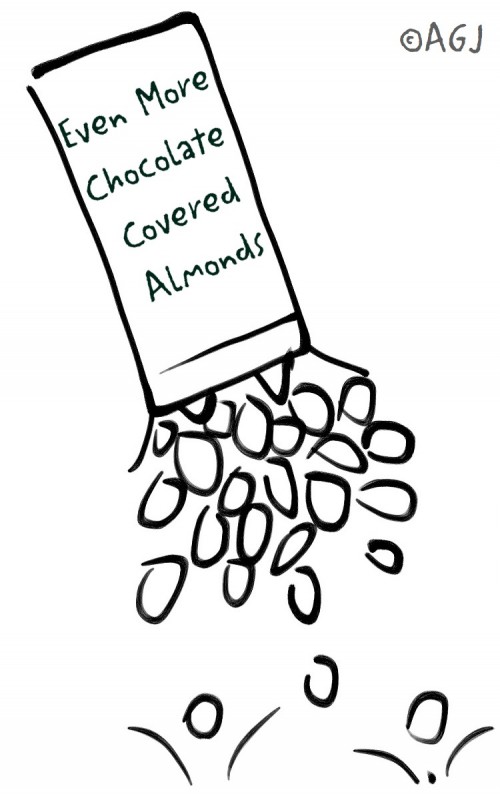
Please, no.
GREAT EXAMPLE: FlipGive recently connected Canadian book giant Indigo with multiple groups of parents across Toronto, all of them determined to raise money for their kids’ school libraries after acquisitions budgets had been slashed. Using FlipGive’s website and mobile app, moms and dads built pages communicating their campaign objectives and started selling $50 gift cards. For every card sold, the retailer donated $20 to the school’s library budget. Meanwhile supporters got not only $50 worth of goods at Indigo, but also the warm feeling of supporting a good cause.
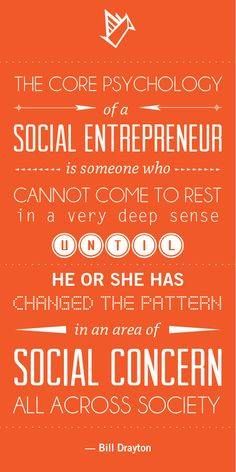 This image was sourced here via FlipGive’s engaging Pinterest board.
March 16, 2014
When Anne-Marie Slaughter stepped away from a possible promotion at the U.S. State Department in 2010 — “my moment to lean in” — she unwittingly became the voice for a generation of women who were reassessing the feminist narrative they had grown up with and always championed: the one that said women can do and have it all.
At the time, Slaughter chose to put her family’s needs over her career advancement. But the lead-up to that decision was so fraught, she later realized, because of the way she and so many of us have been socialized to champion work over family. We don’t typically challenge why men’s work — and women who perform typically men’s work — is advantaged over caregiving responsibilities, she said in a TED talk last summer (see below). “But in the workplace, real equality means valuing family just as much as work, and understanding the two reinforce each other. As a leader and as a manager, I have always acted on the mantra, when family comes first, work does not come second — life comes together.
If Sheryl Sandberg’s message to “Lean In” was a cheerleading push to get women to believe in their talents and negotiating powers, Slaughter’s TED Talk, while it didn’t disagree with Sandberg, finally broached the issue society’s been avoiding for decades: It’s time to enlist men in this balancing act women have been shouldering alone. Why? Because half the population is starting to crumble under its weight. (Happy wife, happy life … all true) In Slaughter’s words, “Changing our workplaces and building infrastructures of care would make a big difference, but we’re not going to get equally valued choices unless we change our culture, and the kind of cultural change required means re-socializing men.” (Applause). It gets better:
“Increasingly in developed countries, women are socialized to believe that our place is no longer only in the home, but men are actually still where they always were. Men are still socialized to believe that they have to be breadwinners, that to derive their self-worth from how high they can climb over other men on a career ladder. The feminist revolution still has a long way to go. It’s certainly not complete. But 60 years after “The Feminine Mystique” was published, many women actually have more choices than men do. We can decide to be a breadwinner, a caregiver, or any combination of the two. When a man, on the other hand, decides to be a caregiver, he puts his manhood on the line. His friends may praise his decision, but underneath, they’re scratching their heads. Isn’t the measure of a man his willingness to compete with other men for power and prestige? And as many women hold that view as men do. We know that lots of women still judge the attractiveness of a man based in large part on how successful he is in his career. A woman can drop out of the work force and still be an attractive partner. For a man, that’s a risky proposition. So as parents and partners, we should be socializing our sons and our husbands to be whatever they want to be, either caregivers or breadwinners. We should be socializing them to make caregiving cool for guys.” (Applause)
But Sandberg gets it. Her current initiative with Getty Images to rid stock photography of sexist stereotypes is one of many things we need to do to recalibrate our cultural expectations and pull men into the household fold. So no more pics of harried working moms balancing briefcases and squawking babies, no workplace bitch slaps staged for the camera, or career women stabbing prostrate men with their stilettos. How about more pics of women looking natural in the workplace and men looking natural being caregivers to their children? Oprah’s favourite mantra, “you gotta see it to be it” — she uses it most often to encourage girls to be astronauts and anchors — applies equally to men. Sandberg knows the power of visuals is undeniable in setting cultural tones around the world. So is, I might add, the power of magazine cover lines. You NEVER see any that ask, “How does he do it all?” Answer: he’s doesn’t.
Slaughter, with her government background and connections, seems poised to lead the charge in changing how we view and deal with what he’s not doing. And she’s embracing it with grace, a steady and searching intelligence and a sense of investment that comes from working through these really tough issues with her own family.
But I don’t want to give away her thunder. Ladies and gents, please welcome to the TED stage Anne-Marie Slaughter:
March 15, 2014

XXIII
I felt a clearing in my mind
As if my brain had split;
I tried to match it, seam by seam,
But could not make them fit.
The thought behind I strove to join
Unto the thought before,
But sequence ravelled out of reach
Like balls upon the floor.
Emily Dickinson
March 13, 2014
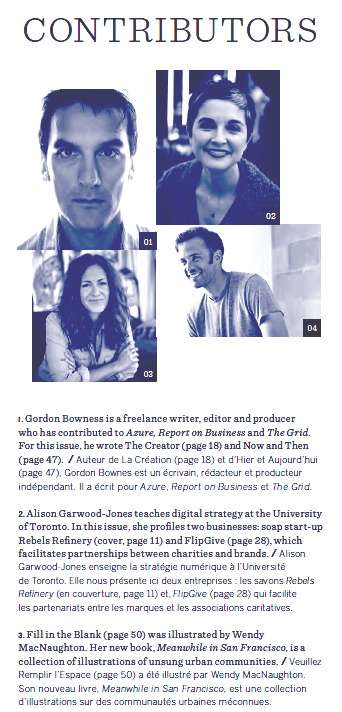
Appearing on the same Contributors’ Page as Wendy MacNaughton feels like an arrival. Seriously. This clip is from a forthcoming issue of The Block, a cool new mag that focuses on the workspaces of Canada’s brainiest tech and design innovators. Details to follow next week.
Do you guys know about MacNaughton? I’ve culled together some of my favourite pieces of hers. You can also click here to learn more about her life and work.





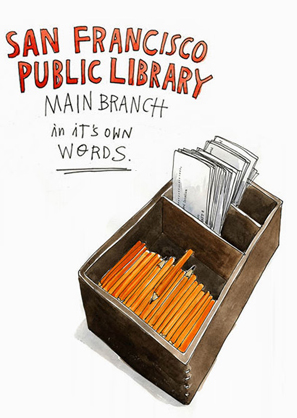
Afterword:

March 10, 2014

“When a little boy asserts himself, he’s called a ‘leader.’ Yet when a little girl does the same, she risks being branded ‘bossy.’ Words like bossy send a message: don’t raise your hand or speak up. By middle school, girls are less interested in leading than boys—a trend that continues into adulthood. Together we can encourage girls to lead.”
This problem isn’t new, but using social media to create an awareness of the word is.
If you’re girl or a guy and you agree that the “B-word” is one more double standard that needs to go “Poof!” then please get on board with the Ban Bossy initiative, started by by Lean In and the Girl Scouts of America. Let’s give girls the chance to assert their best energy and ideas. Let’s also give boys the chance to get used to it. No, really. The Good Men Project was inspired by a similar need to challenge accepted cultural norms about what it means to be a “Real Man.” “Sensitive,” “kind,” and “considerate” aren’t emasculating words, they’re humanizing. Besides, not all guys want to be like Norman Mailer, nor should they feel pressured to follow his example when Jimmy Stewart is more their style.
Negotiating how we share space on this earth takes patience, persistence and the right choice of words. So let’s get talking.
Turn bossy → Badass. This video should help.