©AGJ
Lime rocks
Orange quenches
Cherry … meh
Banana is just plain gross






June 9, 2011
New hashtag: #loAWEcats
Hat tip: @KatTancock‘s cool blog, Magazines Online
May 31, 2011
Boonsri Dickinson, an internet ninja who understands the value of good content
May 27, 2011
Live from the heart of yourself. Yeah, I know you have to make a living, but, still, do it.
Each of us has our own platform. Climb up on it and do something with it.
Show people who you are.
Use your life to serve the world.
Every rock, every flower, every person on earth is energy; make it good energy.
No one completes you (Jerry Maguire, the movie, was wrong). You are responsible for your own life.
I hope my show dropped the veil on all the pretence in the world (about perfect families and perfect lives).
Too many people block their talents and blessings simply because they don’t feel worthy enough to own their own lives. Being alive makes worthiness your birthright.
Everybody wants to be heard. There’s no better feeling than when you know you’ve been heard completely.
Go out and validate someone.
Stay in touch. Here’s my personal email: oprah@oprah.com
May 25, 2011
How would you feel if genome analysis revealed you were predisposed to “early sudden death” from vascular disease? Less hungry for chips? Determined to blow all your savings in Vegas and have as much sex as the day is long? And what if a message in your inbox from a lab in sunny California coldly stated that you had a 98.2 % chance of developing Alzheimer’s since, yup, there it is, you’ve got the “E4 variant” of the APOE gene? Would you be grateful for the knowledge — isn’t all knowledge power in the Information Age? — or annihilated by existential dread, and asking, Now what?
 No, I better not. Well, maybe just one. Och.
If you’re like me, adopted and clueless about the diseases in my family tree, wary of palm readers glaring at my lifeline and the daughter of an adoptive mother in the final stages of Alzheimer’s and a dad dead and gone from heart failure, the arrival of consumer genomics is both unnerving and intriguing. In my case, genetic testing could potentially fill in some blanks in my life story I can’t get the old-fashioned way: by observing family members, then watching my body gradually sink into my mother’s genes.
A three-year search for my birth mother by the Children’s Aid Society yielded zero information about my medical history and only a sprinkling of anecdotes about my birth parents. She was 5’6” with brown hair, blue eyes and a “lively face. She loved to draw and was an “avid reader.” In fact, she went to art school in London, England during the city’s finest hour, the mid-sixties (read: the Stones, the Beatles, Mary Quant minis, velvet suits and jumbled teeth). She met my biological father during a stint in Canada as a nanny. Records describe him as “very tall and striking” and from “a prominent family.” So I was a scandal. She was 19 and he was 20 when my budding existence became undeniable.
I found this out in 2004. Back then the provincial government in Ontario was still keeping a lock on adoption records. But since the summer of 2009 adoption records have been opened and adoptees are now free to find out more information about their medical history and the names on their birth certificates. Actually, I already know my original name: it’s Tagart.  “Hmm, like Dagny Taggart in The Fountainhead and Atlas Shrugged,” said my friend, Ian, an Ayn Rand fanatic. I’m put off by objectivism and haven’t read Rand’s novels, but according to Ian, Ms. Taggart is a beautiful and powerful railway executive who’ll stop at nothing to get what she wants. I feel sweeter than that.
In the meantime, I’ve applied to learn more about my medical history, but getting an answer could take months, even years. And, in the end, I may be no further ahead if my biological parents decide to exercise their right to disclosure vetoes.
Having my DNA sequenced, by comparison, could take 6-8 weeks, yielding genomic data that, among other things, could tell me if I carry inheritable markers for over 20 diseases, like breast cancer and Alzheimer’s, and whether I’m at risk for almost 80 different disorders, such as type 2 diabetes, Parkinson’s and brain aneurysms. It could also predict how I’d react to certain medications, including hormone replacement therapy, which is temping as the decades mount. So should I do it?
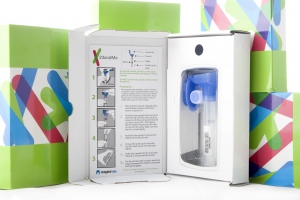 The spit test from 23andMe.com
An editor started me on this journey last year when she called to ask if I’d take on a story about Do-It-Yourself genome sequencing kits. “I want you to go out and find out how the test results from these kits are customizing care,” she said. “How are they changing the face of healthcare by individualizing our treatment options?”
Whether she knew it or not, my editor was echoing Bill Clinton’s Rose Garden speech in the summer of 2000, made not long after scientists wrapped up the Human Genome Project. Back then the president stood at the lectern and predicted:
Human kind is on the verge of gaining immense, new power to heal. Genomics will revolutionize the diagnosis, prevention and treatment of most, if not all human diseases.

And it probably will, but just not now. My story fizzled.
Here’s the deal (and what I told my editor after combing the landscape for hopeful advances). Genome sequencing hasn’t changed primary health care, yet. Experts are unanimous in saying its current impact is very limited. We’re still on the verge of that revolution. Like the dot.com boom a decade ago, it’s another example of us putting too much faith in untested ideas and expecting instant payoff from our technological brilliance.
A good example of that happened last May. The US Food and Drug Administration (FDA) had to acknowledge that the genetic revolution had roared ahead of the health care realities when it abruptly blocked the selling personal genetics testing kits at Walgreens drugstores, just 48 hours before they were due to hit the shelves. The official reason: the boxes were missing an FDA clearance and approval number. The National Society of Genetic Counselors then stepped forward next to identify the real concern: “[R]eceiving genetic information directly from a manufacturer or supplier without input from a qualified health care provider increases the chance for misunderstanding or misinterpretation of results,” they said in an official statement. Also, people need to be “prepar[ed] for what they might learn,” added NSGC president Elizabeth Kearney in the same statement. So we’re back to being on the verge of a genetic revolution.

What we do know for sure is that having the gene for Huntington’s Disease is the only example where, if you’ve got the gene, you’ll get the disease. 100% without a doubt. Genetic testing can also predict if you’re a carrier for cystic fibrosis and Tay Sachs. But we’ve known that and have been testing for those diseases for over 30 years. When it comes to cancer, Alzheimer’s, Parkinson’s and heart disease, there’s no telling if you’ll get any one of these deadly disorders even if the markers on your genes light up like a Christmas tree. Genome sequencing is not a diagnostic tool or, as Steven Pinker says, it’s not like taking a pregnancy test that tells you yes or no if you’re carrying a child.
What’s better ten years after Clinton’s speech are the tools. The genome-sequencing rate is faster; what used to take years can be done in a day. And just as significant is the drop in the price of sequencing, from millions to thousands to just a couple of hundred bucks in a few short years. In a recession, though, it’s a hard sell, especially in the US where these testing companies are based.
When the experts say genomics is having a “limited” impact on medicine, this is what they mean:
• even though the full genome has been sequenced, at this point only 1.5% of all human genes code for the proteins that make up our cells and tissues. Scientists haven’t identified what the rest are doing. As science writer, Brandon Keim, put it in a Wired feature in the spring of 2010 “Even after the publication of hundreds of genome-wide association studies — the gold standard of disease gene hunting, in which thousands of genomes are scanned and compared — scientists can explain only a fraction of the heritability that clearly exists in common diseases and conditions. … But they hope ongoing projects will fill massive gaps that remain in current genetic explanations for most common diseases.”
[pullquote]Huge amounts of data will lead to predictions based on patterns. Only then can therapeutic applications be developed.[/pullquote]
• Last summer, Francis Collins, the director of the National Institutes of Health in Bethesda, MD and director of the National Human Genome Research Institute from 1993-2008, gave an update on genomics in Nature magazine’s April issue. He said “Primary care providers aren’t even close to practicing genetic medicine.” He added, “The most profound consequence of the genetic revolution in the long run will be the development of targeted therapeutics based on a detailed molecular understanding of pathogenesis.” But, again, it hasn’t happened.

Still, reporters continue to buzz around genomics.
Journalists love revolutions, be they in Egypt or in a test tube. Check out Joseph Hall’s “I am Joe’s DNA” in last weekend’s Sunday Star. So far the majority of volunteers who have sent off their spit to be sequenced are Nobel laureates, clinical researchers and journalists. The general public still isn’t interested, even though the price for the kits runs as little as $300 USD through internet-based companies like 23andMe. This Mountain View, California-based biotech company was started by Anne Wojciki, a biologist, biotech analyst and wife of Google co-founder, Sergey Brin. Google is heavily invested in the company. Brin is looking to genomics for a cure for Parkinson’s. His mother has the disease and so may he one day.

23and Me wants to “empower individuals to take bold and informed steps toward self knowledge” and “accelerate research” through the combined potential of the internet and genetics. Once you receive your genetic report card, 23andMe “keeps you up-to-date with the latest biomedical literature so you can understand firsthand how breaking scientific news relates directly to you.”
But the low turnout from the average North American suggests the Genomics Age and the general public haven’t found one another yet — despite efforts to make sequencing understandable, even sexy (23andMe even threw swishy “spit parties”). As of last spring 23andMe has laid off almost half its staff (from 70 to 40). It is also now declining media interviews as it ponders its future. In 2010 Navigenics, another genetic testing company, went through 3 executive officers in a year and deCODE Genetics just “passed through bankruptcy.” All three testing companies are now more focused on selling to doctors, not consumers, says The New York Times.
In 2011, we are in the collecting and analyzing phase of the impending revolution. More data is needed, so more people need to sign on for a spit test. One thing is clear: affordable genetic testing kits are a great example of the crowd sourcing trend started by Wikipedia and Google Analytics — only the data is human DNA. It’s medicine 2.0, as it were. Huge amounts of data will lead to predictions based on patterns. Only then can therapeutic applications be developed.
[pullquote]Genetic testing kits are a great example of the crowd sourcing trend started by Wikipedia and Google Analytics.[/pullquote]
So where does this leave me? No further ahead, really, than when I first started researching genomics and my biological origins.
Right then, back to life.
May 21, 2011
May 19, 2011
We’re living in an era of merging gadgets. Now you can connect your smart phone to your tablet to your laptop and television and stream a movie, a music video, a web series, family photos or a radio podcast right down the conga line of equipment until it hits your TV screen. And let’s face it, TVs are quickly morphing into oversized monitors for magnifying the pint-sized sights and sounds sent first to your palm or lap. But you can also switch directions and stream content from your TV screen back to your phone.
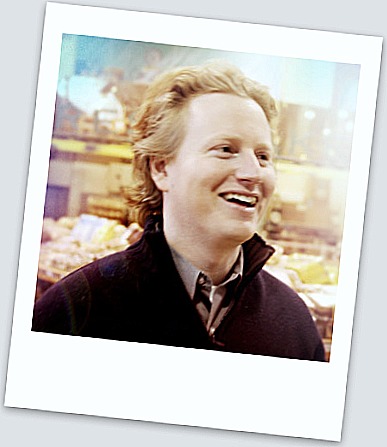 To understand how we got here, I want you to meet Evan Jones (left). Dashing, isn’t he?
Back in the late nineties (or mid-way through Web 1.0), the Dundas, Ontario-native was one of the first to intuit that the online world would one day evolve into a playground for interactive, cross platform entertainment.Mark Zuckerberg followed a similar hunch and invented Facebook, whereas Jones harnessed his story-telling skills — developed as a double major in film and computer science at McMaster University — and emerged a multiple Emmy-Award winning interactive designer of Alternate Reality Games (ARGs). Remember, at that time, the Web only worked in one direction, and linking and liking were unheard of.
The software and tools Evan built from scratch helped move the online world towards the DIY entertainment we now all take for granted as participants of Web 2.0. And, yup, overnight he went from programming small projects in the silence of a cramped Toronto apartment to fielding calls from Microsoft, Disney, FOX, The Movie Network, Discovery and Bell … all in that same cramped apartment. Hey, this ain’t corporate America, folks, it’s the Internet, land of basements and garages piled high with cases of Coke and Red Bull!
 Did you know that Evan was the puppetmaster for the ReGenesis Extended Alternate Reality Game and the Fallen Alternate Reality Game?
[pullquote]Remember the days when the Web only worked in one direction, and linking and liking were unheard of?[/pullquote]
Today Evan and his business partner,Victoria Ha, run Stitch Media out of their Halifax and Toronto offices.
 Stitch focuses on interactive storytelling across multiple platforms, including primetime TV, radio, web and mobile. Their storytelling techniques and working methods are changing how documentaries, websites and films are being created, viewed and thought about.
I wrote about Evan and Stitch Media in a profile for Applied Arts Magazine called
He kindly agreed to appear on my blog too.

AGJ: What attracted you to the digital world?
Evan Jones: I grew up at a great time when computers were exploding with possibilities [Evan’s in his early 30s]. I liked building things through programming and started realizing when I was at university that computer science was really about inventing the software and tools that other people could use to do interesting things. Back then, I was into theatre, radio, doing my own camera work and writing, and I started to wonder how I as going to meld all my hobbies together.
AGJ: That’s when the internet was taking off.
EJ: Right, and all of sudden I saw the chance to marry all of my interests in this new format. The online world was just starting to be about entertainment. This was the late nineties and lots of us started seeing we could have our own ideas and go out and actually build them. Today, I run the Halifax office of Stitch Media out of my home, and within one block of us there are three home-based new media companies on my street. We joke about it being New Media Row.
AGJ: About seven years ago, you made your mark designing and writing the ReGenesis Extended Reality game [produced by Xenophile Media]. It went on to win many international awards and opened up a new form of popular entertainment. Forgive me, but I just don’t get the appeal of ARGs.
EJ: Alternate reality games aren’t like traditional video games. When the world thinks of video games they think of the first-person shooter. In that type of story, you are the protagonist; you’re the hero running through the field with a gun making the action happen. In ARG’s, you’re like the third-part omniscient in the sense that you’re the investigator unfolding the story. You’re the one finding pieces of information, then figuring out how they connect together so the story is told through the audience, not through the storyteller.
AGJ: So, unlike traditional video games, you feel like you’re a part of something real?
EJ: Exactly, and the characters involved in the story believe they’re real. That’s the alternate reality you have to buy into it. You have to believe just as strongly as the characters believe that the events unfolding are real. I’ve worked on projects like the ARG for the Sarah Connor Chronicles [produced by Millions of Us] which is set in the Terminator universe. The ultimate reality that you have to buy into is that the Terminator is being sent back from the future and Judgment Day is upon us at any moment.  As long as you’re willing to play within that fictional universe, then we have a story to tell you. In this game, cameras are sent back from the future to take photos four years into the future. When you aim the camera at your home and upload the picture to our website, our team of graphic designers and illustrators will change the photograph to look like a post apocalyptic version of the photo. In other words, you get to see how your life would be affected by Judgment Day.
AGJ: That’s spooky.
EJ: Let me just add, one of the things I love about ARGs is that we already know how to play them because they’re played in real life. When you’re playing, you contact fellow gamers and the characters in the story by email or cell phone and you solve problems through Google searches. To get the next beat of the story out you need to communicate with everyone via the tools you use everyday. So, you could be going about your day and all of sudden a story line comes through from a character that you recognize and you’re tasked with something you need to do in order to push the story forward.
AGJ: Actually, that does sound like fun, in a stressful kind of way.
EJ: Many of our projects appeal to a hardcore audience that spends a good deal of time online and is willing to investigate a story at length.
AGJ: You also created much lighter touch projects that are pure entertainment and don’t require any investigative skills. What’s your favourite?
EJ: “Moderation Town.” It’s an original web series that Showcase, a traditional television production company, commissioned for the Web.
AGJ: What’s it about?
EJ: It’s a comedy about what happens in a Maritime town after the local factory closes and is replaced by an Internet moderation company. The locals know next to nothing about the internet but they’re forced to take on new jobs as content moderators, so they’re responsible for filtering out the most offensive content on the Internet.
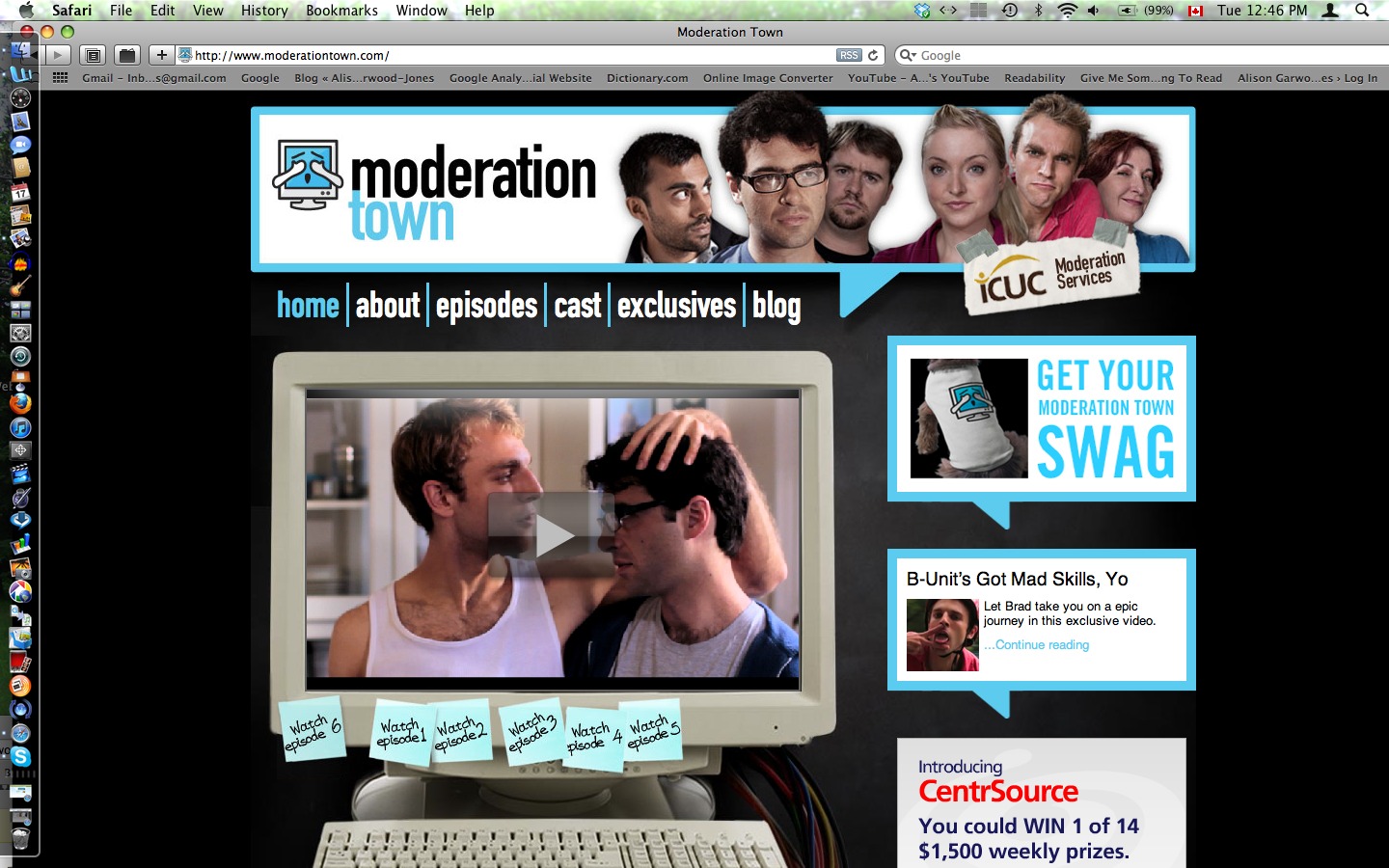
AGJ: As we shift from manufacturing to digital economy, is this really happening?
EJ: Well, I feel like I’ve placed myself in that landscape. We work on a lot of brands with a lot of creative and all of these projects, after a certain time, require someone to moderate. The budget runs out and it’s up to the original producer to be moderator. I’ve seen a lot of stuff get submitted to different projects that I wish I’d never seen! Online there’s an amazing culture of anonymity and it changes the way people act. When you get exposed to the way folks flame each other — through porn and swearing — and it can turn you into a really jaded person. I started reading up on this and found that I wasn’t the only one who was disturbed by what was going on.
But back to your original question: a lot of factory towns on the East Coast have lost their main industries and turned into ghost towns. But most are reinventing themselves as call centres. Some of them are even developing accents from other regions! I just thought it would be fun to watch the follies of small town reinventing itself as internet moderators. I’d love to see the show become an up-to-the-minute portal for people wanting to find out what bizarre things are happening online, other than LOLcats.
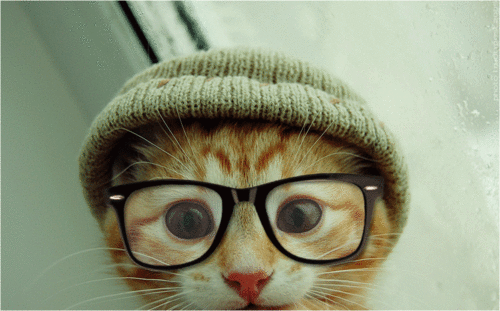
Thanks for posting this, @laurenonizzle!
For other Q&A’s from my “In Conversation” Series, see my interview with design guru, Bruce Mau, and Gemini Award-winning filmmaker, Maureen Judge.
May 16, 2011
One of the things I like best about journalism is how it shrinks the phenomenon of Six Degrees of Separation — the idea that we’re all six steps away from any other person on earth — right down to zero so that one day you find yourself standing face-to-face with Kevin Bacon and asking him all sorts of impertinent questions about his personal life and career.
I haven’t met Bacon, yet, but I have stood close enough to Robert Kennedy Jr. to study the parrots on his tie and ask him questions about growing up Kennedy. He said when he was a kid his mom would send him outside when he complained of feeling sick. “She thought the sun cured everything.”
I noticed he wore the parrot tie again in a photo shoot for New York Magazine:

(Photo: Jason Schmidt)
I’ve also sat beside the late great Dame Anita Roddick, founder of The Body Shop. She smelled like vanilla. I asked her tons of questions about her human rights activism as she squeezed my arm red to emphasize the changes that were needed in the world. I liked her immediately and I miss her influence.
Later, stuffed in a back room with Paris Hilton, the heiress stretched her arms up over her head half way through our interview and squealed out a yawn before telling me, “I have to pee.” Was it something I said?
When I met the lithe Liz Hurley, she scanned me from top to bottom and remarked in a plummy accent, “Good God, you’re tall. Are you Dutch?” I’m not, and we sat down for a nice lunch and a chat about Hugh Grant. He lives down the street from her in London, and is god father to her son. Frankly, I think they’ve been married in spirit since they first laid eyes on each other.
When I met my writing hero Gay Talese, he had me at hello.
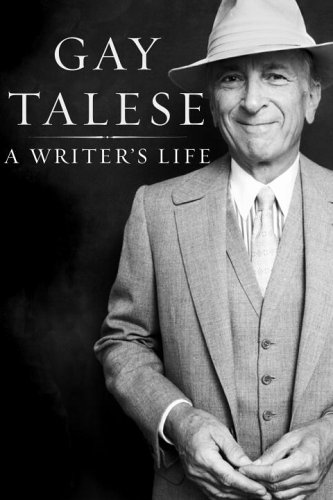 (Photo: Joyce Tenneson)
Gay smiled at me, just like he’s doing in the picture above, then asked me my name. “Alison,” I replied, with a grin so wide you would have thought two coat hangers were pulling back the corners of my mouth.”And your last name?” he asked. “Wait! Don’t tell me,” he interjected. “You”ll probably change it!” — like I was about to get married, or something. I ended up talking with New York’s biggest flirt about the challenges of the writing life, being an editor at Elle and what it was like to be so tall.
Back when I was an art historian, I shared a desk at the Smithsonian with Alex Nemerov, the nephew of legendary photographer, Diane Arbus (Nicole Kidman played her in a 2006 film). Alex kept nudging me, saying I was space hog with my books and papers and once left me a sweet note with a volume on “Manifest Destiny” to make his point. Today he’s an art history professor at Yale.
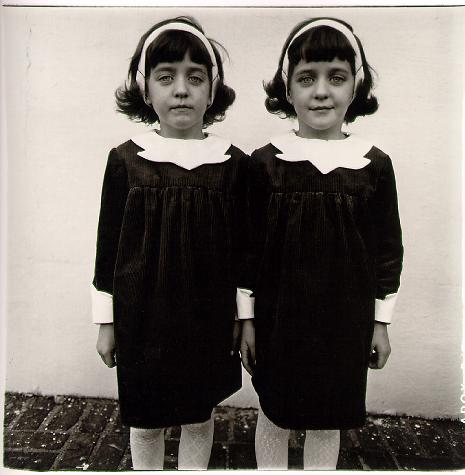 Diane Arbus, “Identical Twins,” Roselle, New Jersey, 1967
Years later, I spent an afternoon with actor Peter Keleghan that was just plain silly. I loved every minute of the interview and photo shoot with the star of The Newsroom, Made in Canada and most recently 18-to-Life. No one, except maybe Alec Baldwin, is as good as Keleghan at playing vain and fatuous characters. He even played one on Seinfeld.
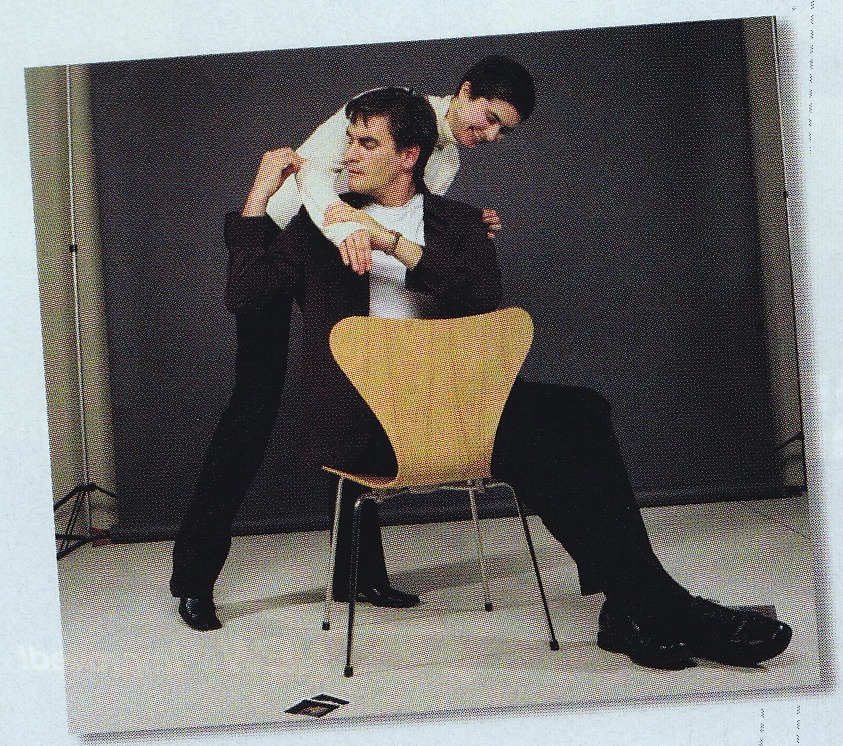
“Wait, I gotta get the lint off.” (Photo: Evan Dion)
Three weeks ago, when I was in New York, I had dinner with a friend who had lunch the week before with Sergey Brin, the co-founder of Google, and his wife Anne Wojcicki. My friend is a neuroscientist specializing in Parkinson’s research and Wojcicki is the founder of 23andMe, a genetic testing company funded in part by Google. Brin is looking to genomics for a cure for Parkinson’s. His mother has the disease and so may he one day.
Unlike my friend, I haven’t met Brin. Yet. But maybe, just maybe, I can write my way towards him.
That’s the beauty of journalism.
May 11, 2011



It’s time to stock up on new bathroom reading. Let me help you. The June issue of Canadian House and Home is packed with ideas for budget-conscious design freaks and includes an article I wrote about a Georgian Bay cottage. The owners, Juli Daoust and John Baker, are the proprietors of Mjölk (“Milk”), a Scandinavian and Japanese lifestyle store in Toronto’s Junction. Through their eye-catching street presence and the internet’s word-of-mouth power, Juli and John have turned their two-year old store and their travel and design blog into sought-after destinations in Toronto and around the globe. Talent rises fast, as it should. For the full article, click here.